Home › Blog › The Unified AI Cockpit
The Unified AI Cockpit: What One Front End for Salesforce and Your ERP Costs in 2026
Last updated: July 17, 2026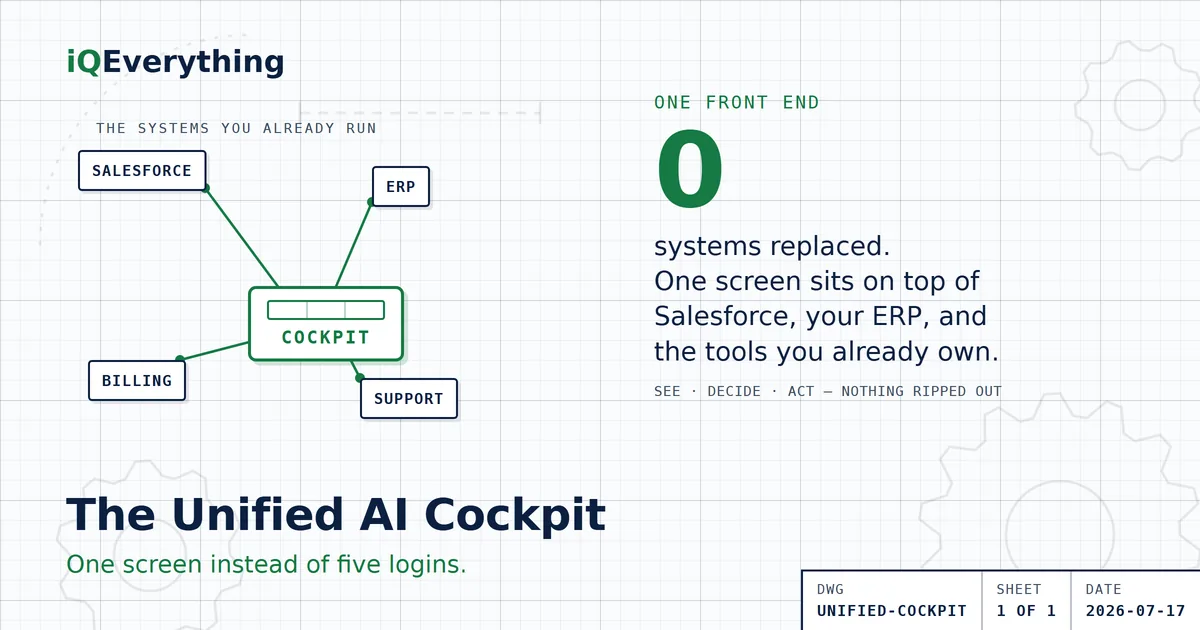
The short answer: a unified cockpit is one screen on top of the systems you already run — Salesforce, your ERP, and the bolt-on tools between them. It doesn’t replace any of them; a connective layer links them and a single interface presents the combined picture. The market converges on two sizes: a lean build (iPaaS plus a focused dashboard) at roughly $65,000–$150,000 all-in, and a full build (custom integration plus a multi-team cockpit) at roughly $200,000–$500,000+ — either one plus 15–20% a year in maintenance.
Because the true cost of owning a SaaS stack runs 2.5× to 4× its sticker price once integration is counted, connecting what you own usually beats ripping it out and rebuilding. Here is how the numbers break down.
Most growing businesses don’t have a software problem. They have a software sprawl problem — Salesforce here, an ERP there, and a half-dozen bolt-on tools that seemed like a good idea when they were bought and now sit mostly unused. Nobody on the team has one screen that shows the whole business. A unified cockpit is the fix that keeps every one of those systems in place and simply puts a single front end on top of them.
This is the build-or-connect question from the 2026 Guide to SaaS Overload, priced out. Every figure below comes from more than a dozen independent, named 2026 market sources — vendor pricing pages, implementation partners, and boutique consulting firms — cross-checked against each other. Where a number is called corroborated, at least two unrelated sources landed on the same range on their own.
What is a unified AI cockpit, exactly?
A unified cockpit is a single front end — a dashboard, or a conversational chat-style interface — that sits on top of the systems a business already runs. It gives the team one place to see and act on all of it. That distinction matters, because it’s a fundamentally different, and usually far cheaper, project than replacing those systems outright.
- The systems underneath stay exactly as they are. Salesforce is still Salesforce; the ERP is still the ERP. Nothing gets migrated or thrown away.
- A connective layer links them together. That’s either off-the-shelf middleware or custom-built integration code — the single biggest driver of the total cost, covered next.
- One interface on top presents the combined picture. One screen instead of five logins: the whole business, visible and actionable in a single place.
iPaaS or custom integration — which connective layer?
Every source reviewed for this study splits the integration approach into the same two paths, and the choice between them is the single biggest driver of total cost:
- iPaaS (Integration Platform as a Service). A middleware layer such as MuleSoft, Boomi, or Workato, with pre-built connectors for common systems. Faster to stand up, carries an ongoing subscription, and the best fit when the systems involved are standard and well-documented.
- Custom / native integration. Code built directly against each system’s API. Higher upfront cost, no recurring platform fee, and the right choice when a system is legacy, heavily customized, or simply has no pre-built connector available.
For a mainstream stack — Salesforce, a standard ERP, and common bolt-ons — iPaaS is usually the cheaper way in, because pre-built connectors likely already exist for most of what you run. Custom integration earns its higher price only where a system genuinely has no connector or needs deep, bespoke logic.
What does it cost to actually build the connection?
The subscription is only part of the bill. Someone still has to map the data, handle the transformations between systems, and test the whole thing before it goes live — and this is where most quotes in the market are underscoped:
| Integration type | Typical cost | What it covers |
|---|---|---|
| Standard ERP-to-CRM integration via middleware | $10,000 – $40,000 | Design + development + testing |
| Full implementation services (mid-market) | $25,000 – $250,000+ | Depends on scope and number of modules |
| Custom managed-package build (no middleware) | $75,000 – $400,000 one-time | Plus ongoing maintenance |
The line most proposals leave out: ongoing maintenance after launch is quoted consistently across sources at 15–20% of the implementation cost, per year. Any proposal that doesn’t include it as a standing line item is underscoped — budget it from day one.
Lean or full: two realistic paths, priced out
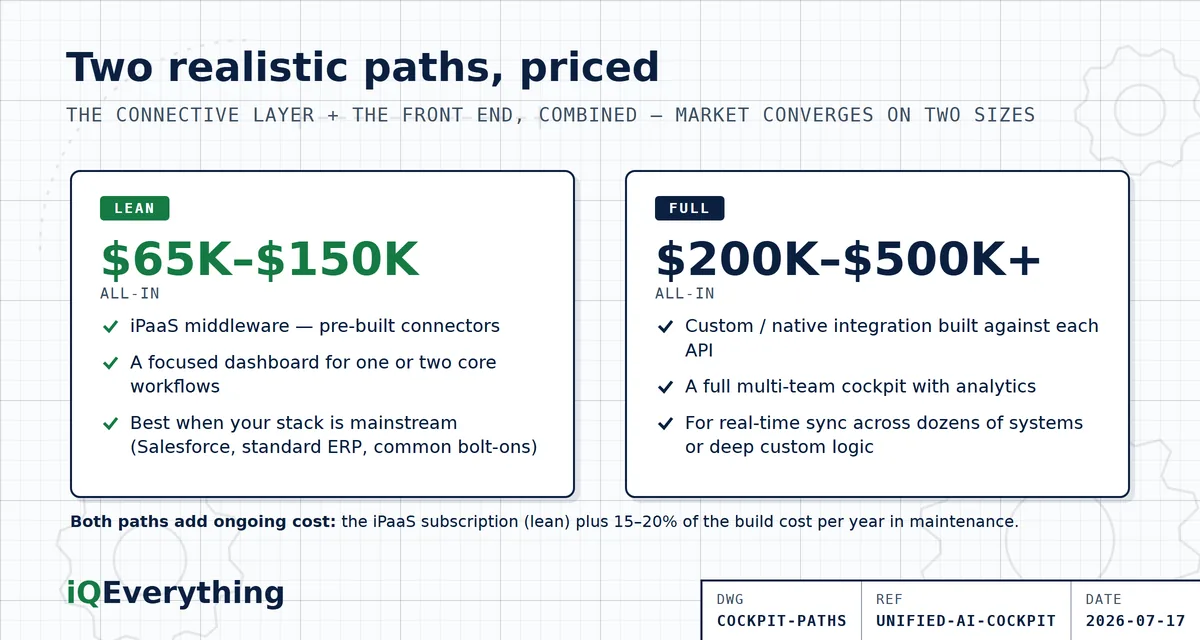
Combine the connective layer with the front-end cockpit itself, and the market converges on two clear engagement sizes:
- Lean version — iPaaS plus a focused dashboard covering one or two core workflows: roughly $65,000–$150,000 all-in, plus the ongoing iPaaS subscription and 15–20% annual maintenance.
- Full version — custom integration plus a full, multi-team cockpit with analytics: roughly $200,000–$500,000+ all-in, plus $135,000+/year ongoing at true enterprise scale.
For a business running a mainstream stack, the lean version is very often the realistic starting point, since pre-built connectors likely already exist for most of what’s in place. The full version becomes necessary when real-time synchronization across dozens of systems, or deep custom logic, is genuinely required.
What’s the first-year cost by company size?
Looking at the fully-loaded first year — consulting, platform, and build combined — multiple independent boutique AI-consulting sources converge on a comparable band:
| Client size | Year-one total | Ongoing annual (year 2+) |
|---|---|---|
| Mid-market (100–2,000 employees) | $75,000 – $200,000 | 15–20% of build cost |
| Enterprise (Big 4 / full-platform scope, 1,000+ employees) | $500,000 – $5,000,000+ | Scales with modules and headcount |
The enterprise figure reflects a genuinely large-scale transformation — real-time sync across dozens of systems, custom model work, Big 4-scope engagements. Most businesses running a mainstream stack (a CRM, an ERP, and a handful of bolt-ons) fall well below it; the mid-market and lean-version ranges are the more realistic comparison point.
What about the front end itself?
Separate from the back-end integration is the cockpit interface itself — the dashboard or chat-style front end a team uses every day. This is priced like any mid-tier internal software tool:
| Front-end complexity | Typical cost |
|---|---|
| Single-department workflow tool, basic automation | $40,000 – $100,000 |
| Mid-tier CRM-style dashboard (multi-team, automation, email integration) | $80,000 – $200,000 |
| Cross-department platform (multi-role access, audit trail) | $100,000 – $300,000 |
| Full custom analytics + AI-driven insights, deep ERP integration | $200,000 – $400,000+ |
Why is a cockpit usually the right first move?
The alternative to a unified cockpit is walking away from the existing systems entirely and building something new from scratch. That’s a legitimate path for some businesses — but it’s a much larger commitment, and the market data is unambiguous about the gap.
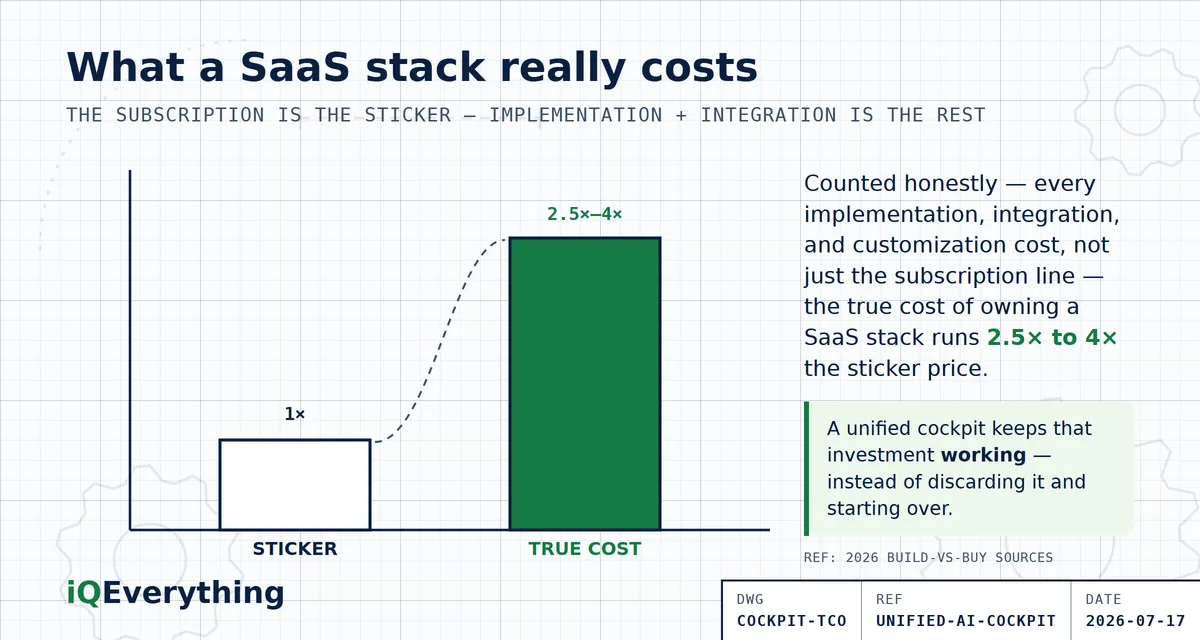
The true total cost of owning a SaaS stack — once every implementation, integration, and customization cost is counted, not just the subscription line — runs 2.5× to 4× the sticker price, a figure that shows up independently across multiple unrelated sources. A unified cockpit keeps that existing investment working, rather than discarding it and starting over. It’s the lower-risk, faster-to-value option in the large majority of cases.
What this means in practice
- A cockpit is the right fit when the goal is visibility and workflow efficiency across systems that are otherwise working fine on their own.
- The maintenance conversation (15–20% annually) should be part of the proposal from day one — it’s the most consistently underscoped line item across every source reviewed.
- A full custom rebuild — replacing every system, not just connecting them — is a materially larger commitment, and the right call only when the math clearly proves it. That comparison is the subject of the consolidate-vs-build guide.
Where a Systems Study fits
Before committing to either path — a unified cockpit or a fully custom rebuild — the responsible first step is an evaluation. That’s what our Systems Study is: a paid, fixed-scope engagement that inventories what’s actually in use, maps the friction where the team loses time moving between systems, and delivers two concrete blueprints priced against your real situation — a unified front end on the systems you keep, and a build plan for one fully owned system. The numbers in this guide are the starting reference point, not a substitute for that evaluation. The study is yours to keep whether you build with us or hand it to your own team.
Frequently asked questions
What is a unified AI cockpit?
A single front end — a dashboard or a conversational, chat-style interface — that sits on top of the systems a business already runs. It doesn’t replace Salesforce, your ERP, or the bolt-on tools underneath; it links them through a connective layer and gives the team one screen to see and act on all of it, instead of five separate logins. Building a cockpit is a fundamentally different, and usually far cheaper, project than replacing those systems outright.
How much does a unified cockpit cost in 2026?
The market converges on two sizes. A lean version — iPaaS middleware plus a focused dashboard covering one or two core workflows — runs roughly $65,000 to $150,000 all-in, plus the ongoing iPaaS subscription and 15–20% annual maintenance. A full version — custom integration plus a multi-team cockpit with analytics — runs roughly $200,000 to $500,000+ all-in. For a mainstream stack, the lean version is very often the realistic starting point. Sources: Bosio Digital (2026); Velsof (2026); Appnigma (2026); Cloudywave (2026).
Is iPaaS or custom integration cheaper for connecting Salesforce and an ERP?
For a mainstream stack, iPaaS is usually cheaper to stand up. Middleware such as MuleSoft, Boomi, or Workato ships pre-built connectors, so it’s faster to deploy but carries an ongoing subscription. Custom or native integration is code built directly against each API — a higher upfront cost with no recurring platform fee, and the right choice only when a system is legacy, heavily customized, or has no connector. A standard ERP-to-CRM integration via middleware typically runs $10,000 to $40,000; a custom managed-package build runs $75,000 to $400,000 one-time. Sources: Sigma Infosolutions, Appnigma, Cloudywave (2026).
Does a unified cockpit replace Salesforce or my ERP?
No. The systems underneath stay exactly as they are. A cockpit adds a connective layer that links them and a single interface on top that presents the combined picture. It’s the right fit when the goal is visibility and workflow efficiency across systems that are otherwise working fine on their own. Replacing every system with something built from scratch is a separate, much larger commitment.
Is a cockpit cheaper than replacing my systems?
Usually, yes. The true total cost of owning a SaaS stack — once every implementation, integration, and customization cost is counted, not just the subscription line — runs 2.5× to 4× the sticker price, a figure that shows up independently across multiple unrelated 2026 sources. A unified cockpit keeps that existing investment working rather than discarding it and starting over, which makes it the lower-risk, faster-to-value option in the large majority of cases. Sources: Aerosoft, CMARIX, MarketersMedia (2026).
Want your cockpit priced against your real stack?
A Systems Study inventories every tool and seat, maps where the hours go, and hands you two costed blueprints — a unified front end on what you keep, and a build plan for one owned system — so the decision is arithmetic, not a hunch.
Book a Strategy CallOr call or text (615) 628-7386 — a human answers.