Home › Blog › Consolidate vs Custom Build
Consolidate Your SaaS or Build Custom? How to Make the Call
Last updated: July 14, 2026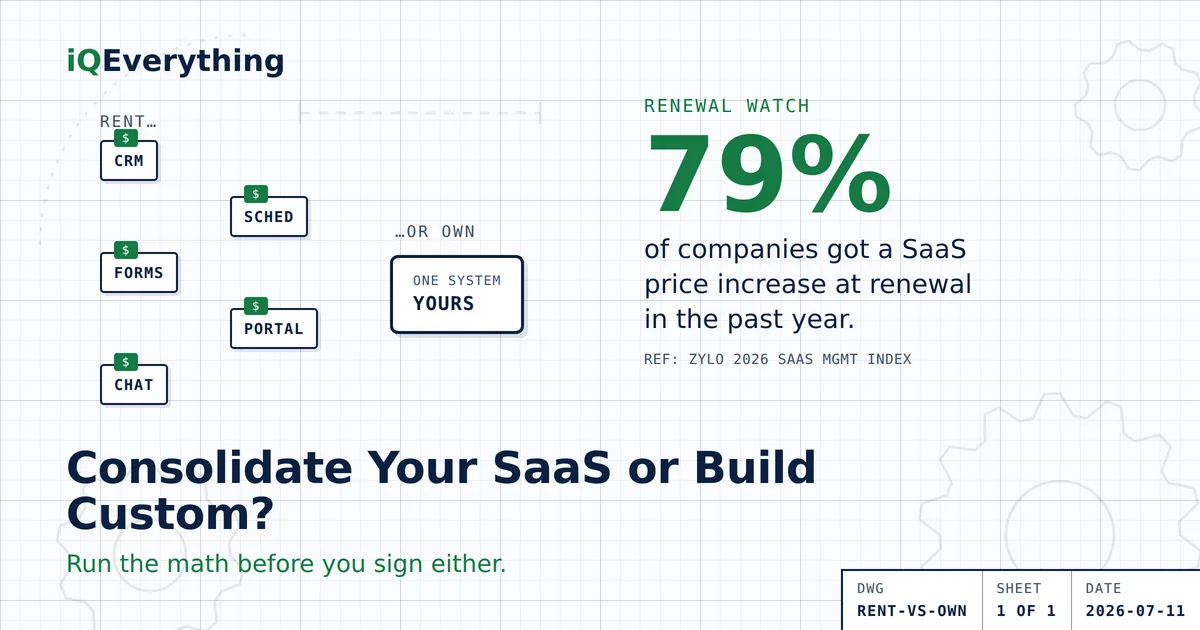
The short answer: consolidate first, and build custom only where the math clearly wins. Consolidation pays back next month — cancel the dead seats and duplicates and the savings start immediately. A custom build pays back in years: you spend real money up front to stop paying rent on a workflow forever. The deciding factor isn’t technology. It’s arithmetic, plus one honest question: is this workflow core to how you make money, and is it stable?
This guide runs that arithmetic — the real costs on both sides, the break-even math, and the five questions that settle it.
This is the decision at the heart of the consolidate-connect-replace framework, and it’s the one businesses get talked into fastest — in both directions. Software developers will tell you to build; subscription vendors will tell you to keep renewing. Both of them are selling. The numbers aren’t.
What does consolidating actually save?
Consolidation is three moves: cancel what nobody uses, collapse duplicates into one tool, and renegotiate what’s left.
The waste it attacks is well documented. Zylo’s 2026 SaaS Management Index puts 36% of paid licenses completely unused, with median SaaS spend running $9,455 per employee per year. And doing nothing gets more expensive on its own: 79% of companies were hit with a SaaS price increase at renewal in the past year (Zylo). We walk the small-business version of this math in What SaaS Sprawl Costs a Small Business.
Consolidation’s strengths: immediate payback, zero build risk, and it forces the inventory you need for any later decision anyway. Its limit: it can’t fix the deeper problem of tools that don’t talk to each other. Consolidate alone and you end up with a cheaper version of the same fragmentation.
What does a custom build actually cost?
Honest ranges, because this is where the advice usually goes vague:
- A simple internal tool — one workflow, a few screens, one data store — typically lands in the low five figures.
- A system that replaces a core platform — your scheduling-plus-CRM combo, say — is a mid-five to six-figure project done properly.
- Upkeep is not optional. A common rule of thumb: budget 15–20% of the build cost per year for hosting, security updates, and small changes. Software you own has no subscription — but it still has a utility bill.
The trap runs both directions. Leaving out upkeep makes custom look artificially cheap. Ignoring per-seat growth makes SaaS look artificially cheap — your subscription bill isn’t fixed; it grows every time you hire, and it jumps almost every renewal.
Where’s the break-even point?
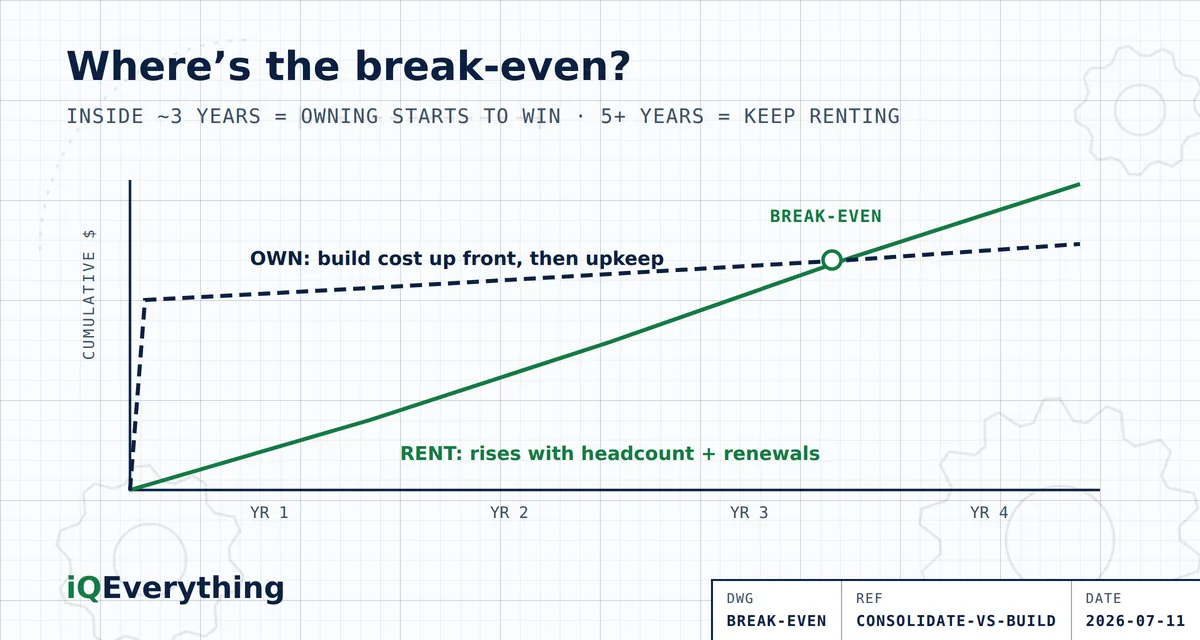
The simple version of the math we run in a Systems Study:
- Take the annual cost of the subscriptions the custom system would retire — at your headcount two years from now, not today.
- Take the build estimate plus two years of upkeep. (Build × 1.35 is a fair shorthand.)
- Compare. If the build pays for itself inside roughly three years and the workflow is stable, owning starts to win. Five years or more? Keep renting.
A worked illustration (round numbers, not a quote): a service business pays $1,400 a month across a scheduling platform, a forms tool, and a client-portal add-on — $16,800 a year, and rising with headcount. A custom replacement estimated at $45,000 runs about $61,000 over two years with upkeep, while the subscriptions would have cost $33,600 and kept going forever. Break-even lands around year four at today’s prices — sooner at next year’s. That one is a judgment call. If the same subscriptions cost $2,500 a month, it isn’t.
Is there a middle path?
Yes — and it’s the one most businesses should take first: connect. Keep the platforms that earn their keep and put one interface on top, with AI agents working through the APIs of the systems you already own.
Connecting first does two things for a later build decision. It shows you which tools your business actually uses once the friction is gone. And it often shrinks the question from “replace the platform” to “replace one overpriced piece of it” — a five-figure decision instead of a six-figure one.
How do you decide? Five questions
| # | Ask this | What the answer tells you |
|---|---|---|
| 1 | Is the workflow core to how you make money? | Core workflows can justify ownership. Commodity workflows (email, accounting, payroll) almost never do — consolidate those. |
| 2 | Is the workflow stable? | If how you work changes every quarter, custom software becomes a rewrite subscription. Rent flexibility; own stability. |
| 3 | What do the retired subscriptions cost at future headcount? | Per-seat pricing means the rent rises as you grow. Run the math at the team size you’re hiring toward. |
| 4 | Who maintains it? | If the answer is “the developer we hope still answers email,” that’s a risk line-item. A build without a maintenance plan is a liability with a login page. |
| 5 | Have you consolidated and connected first? | If not, you’re pricing a build against an inflated baseline. Cut the waste, connect the keepers, then price what’s left. |
Frequently asked questions
Is it cheaper to build custom software than to keep paying for SaaS?
Sometimes — but only for stable, core workflows where the retired subscriptions would cost more within roughly three years than the build plus its upkeep. For everything else, consolidating and connecting what you already own delivers most of the savings with none of the build risk.
What should I consolidate before considering a custom build?
Unused seats, duplicate tools in the same category, and add-ons that patch gaps between platforms. Consolidating first gives you a true baseline cost — and connecting the tools you keep often eliminates the reason you wanted custom software at all.
How much does custom business software cost to maintain?
A common rule of thumb is 15–20% of the original build cost per year for hosting, security updates, and small changes. Software you own has no subscription, but it still has a utility bill — leaving upkeep out of the math is how custom builds get oversold.
When does building custom software clearly make sense?
When a per-seat platform charges you more every year for a workflow that is core to your business, hasn’t changed materially in years, and would pay for its own replacement within about three years. That combination is rarer than software salespeople suggest — and more common than subscription vendors admit.
Should a small business ever start with a custom build?
Rarely. Start by consolidating and connecting what you already pay for. The exception is a business whose core offering IS the workflow — where the software is the product, not the plumbing.
Want the math run on your actual stack?
Bring your subscription list to a strategy call. We’ll flag which tools are consolidation candidates — and whether anything in your stack clears the bar for a custom build.
Book a Strategy CallOr call or text (615) 628-7386 — a human answers.