Home › Blog › What SaaS Sprawl Costs
What SaaS Sprawl Costs a Small Business: The Real Math
Last updated: September 24, 2026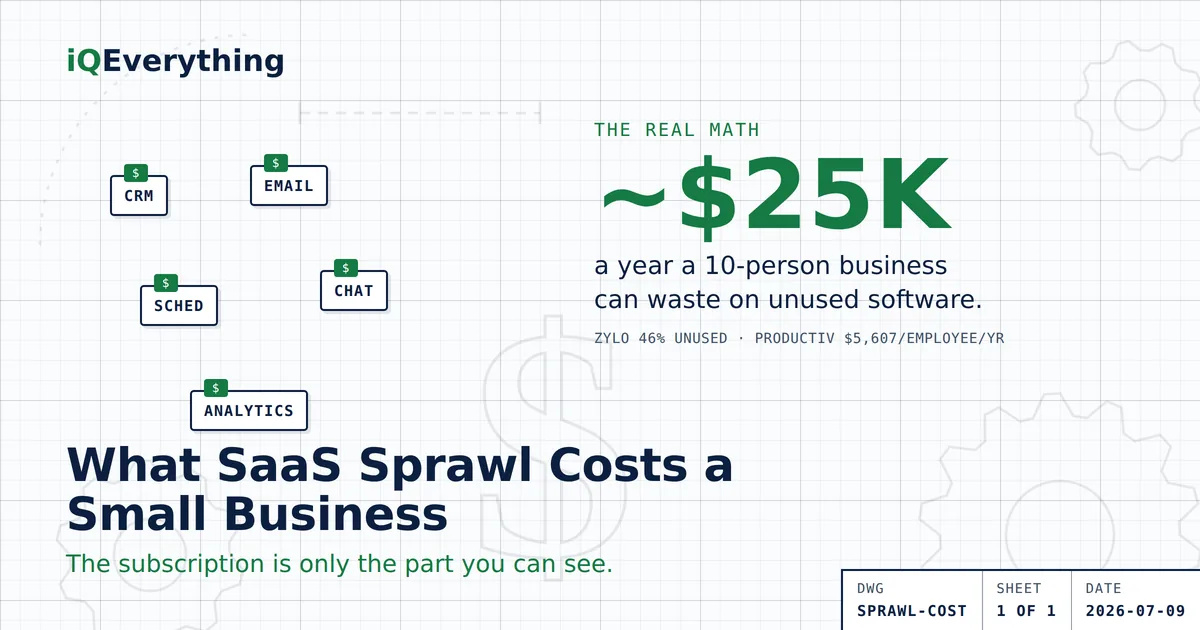
The short answer: about 46% of the software licenses a business pays for go unused (Zylo, 2026 SaaS Management Index). At a median of roughly $9,455 per employee per year in SaaS spend (Zylo, 2026), a 10-person small business can be paying for around $43,000 a year of software nobody touches — before you count the hidden cost of the hours lost moving data between tools by hand.
Your real number takes about an afternoon to find. Here's the math, the hidden costs most owners miss, and how to calculate your own.
“It's just a few subscriptions” is the most expensive sentence in a small business. Individually, each tool looks cheap — thirty dollars here, a couple hundred there. It's the pile that gets you, and the pile is bigger than almost every owner guesses, because software waste is designed to be invisible: it bills automatically, it never sends a “you didn't use this” notice, and it hides among dozens of other line items on a card statement.
Let's make it visible. This is the cost half of SaaS overload — if you want the full playbook for fixing it, start with the pillar guide. Here, we're just going to put a dollar figure on the problem.
How much does the average business waste on unused software?
Start with the headline number from Zylo's 2026 SaaS Management Index: the average organization uses just 54% of the licenses it pays for. The other 46% is paid for and never used. And that waste shows up fast — 49% of licenses go unused within 30 days of purchase. So this isn't slow erosion over years; a big chunk of software is bought and forgotten almost immediately.
Now put a price on it. Zylo’s 2026 SaaS Management Index puts median SaaS spend at about $9,455 per employee per year. Multiply by your headcount and you have a rough total software bill. Apply the 46% waste figure and you have a rough estimate of what you're spending on nothing.
| Business size | Rough annual SaaS spend | Estimated waste at 46% unused |
|---|---|---|
| 5 people | ~$47,000 | ~$21,700 |
| 10 people | ~$94,500 | ~$43,500 |
| 25 people | ~$236,000 | ~$108,700 |
These are averages, not your invoice — some businesses spend less per head, some far more. But even if your real waste is half the benchmark, a 10-person shop is still looking at five figures a year going out the door for login screens nobody visits.
The costs hiding behind the subscription fee
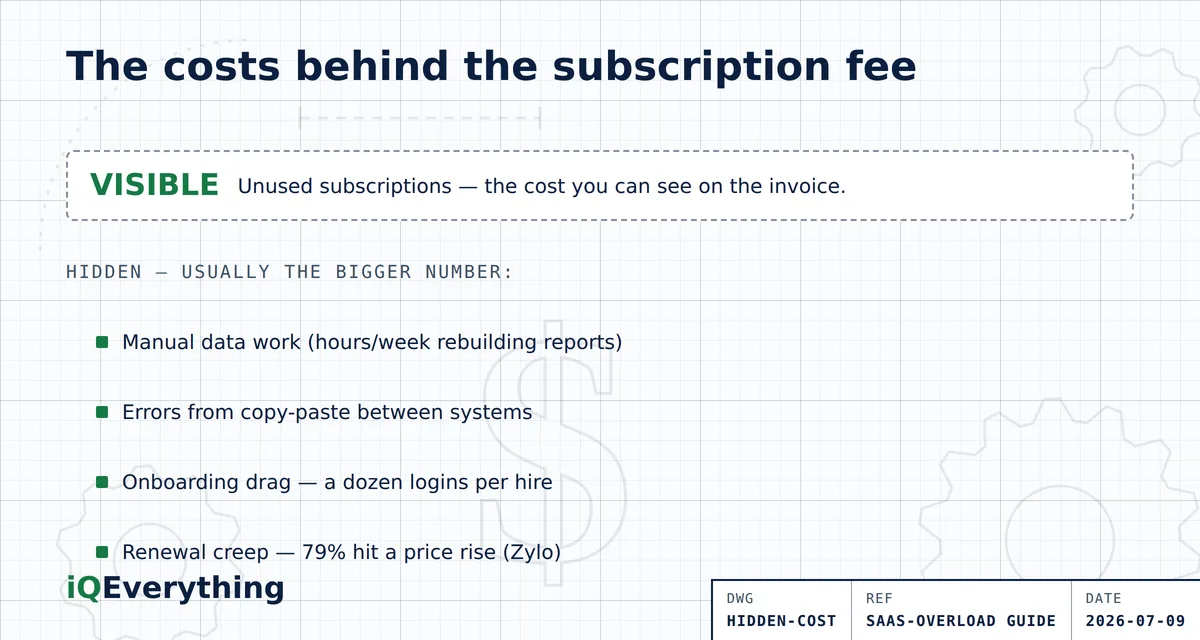
The unused licenses are the cost you can see. For a lot of small businesses, the bigger number is the one you can't — the time your disconnected tools quietly eat:
- Manual data work. Every hour someone spends copying numbers from one tool into another, or rebuilding the same report by hand each week, is a labor cost your software was supposed to eliminate. Tools that don't talk to each other turn your team into the integration.
- Errors from manual transfers. Copy-paste between systems is where wrong numbers are born. The cost of one bad figure in a client report or an invoice can dwarf a monthly subscription.
- Onboarding drag. If a new hire needs a dozen logins before they can work, that's paid time lost to setup — every time you hire.
- Renewal creep. 79% of companies faced a SaaS price increase at renewal in the past year (Zylo, 2026). Prices ratchet up quietly, and inertia pays them.
Add these to the subscription waste and you get the true cost of sprawl. For many small businesses, the wasted hours outweigh the wasted licenses — which is why simply canceling tools only solves half the problem.
How to find your own number
You don't need a consultant or software for this — a spreadsheet and an afternoon will do:
- List every subscription. Pull your last three months of card and bank statements and write down every software charge. This step alone usually surfaces one or two “wait, we still pay for that?” tools.
- Write the annual cost. Monthly fee times twelve for each. Annual numbers land differently than monthly ones.
- Count paid vs. used seats. For each tool, note licenses you pay for versus people who actually log in. Most tools show last-login on an admin or billing screen. The gap is your direct waste.
- Estimate the manual hours. Ask your team: how much time per week goes to moving data between tools or rebuilding reports by hand? Multiply by an hourly cost. That's your hidden cost.
Add the direct waste and the hidden cost, and you have a real, defensible number — the actual price your business pays for sprawl every year.
What to do with the money you free up
The first answer is simple: keep it. Canceled waste is immediate margin — it drops straight to the bottom line with no downside. But the smarter move for the hidden-cost half is to reinvest a slice into connecting the tools you keep, so your team stops losing hours to manual data work. Connecting your existing systems almost always returns more than the next new subscription would, because it kills the hidden cost instead of adding to it.
That's the whole argument of the 2026 Guide to SaaS Overload: cut the waste, connect what's left, and replace a platform only when the math proves it. The savings you just calculated are what funds the fix.
Frequently asked questions
How much money do small businesses waste on unused software?
Roughly 46% of paid SaaS licenses go unused (Zylo, 2026 SaaS Management Index). At a median of about $9,455 per employee per year (Zylo, 2026), a 10-person business could be paying for around $43,000 a year of software nobody touches. Your own number depends on your actual tools and headcount, but the waste is rarely small.
How do I calculate what my software subscriptions really cost?
List every subscription and its monthly cost, multiply by 12, then for each tool note paid licenses versus people who actually log in. The gap is your direct waste. Add the hidden cost — hours spent moving data between tools by hand — to get the true number.
What are the hidden costs beyond the subscription fee?
The subscription is only the visible cost. The hidden ones are the hours spent copying data between disconnected tools, the errors from manual transfers, onboarding time lost to a dozen logins, and renewal price increases — 79% of companies faced one in the past year (Zylo). For many small businesses the wasted time costs more than the wasted licenses.
Is SaaS sprawl really a big deal for a small business?
Yes — proportionally more than for a large one. A big company can absorb wasted licenses; a small business feels every dollar. At $9,455 per employee per year, even a few idle licenses and a few hours a week of manual data work adds up to money that could fund a hire, a campaign, or simply profit.
What should I do with the money I save?
First, keep it — canceled waste is immediate margin. Then consider reinvesting a portion into connecting the tools you keep, so your team stops losing hours to manual work. Connecting your existing systems usually returns more than the next new subscription, because it attacks the hidden cost rather than adding to it.
Want your real number, not the average?
Bring your subscription list to a strategy call and we'll help you find what sprawl is actually costing you — and what it'd take to get it back.
Book a Strategy CallOr call or text (615) 628-7386 — a human answers.