Home › Blog › Missed After-Hours Calls
What Does a Missed After-Hours Call Cost a Plumber? The Math for Any Local Service Business
Last updated: September 24, 2026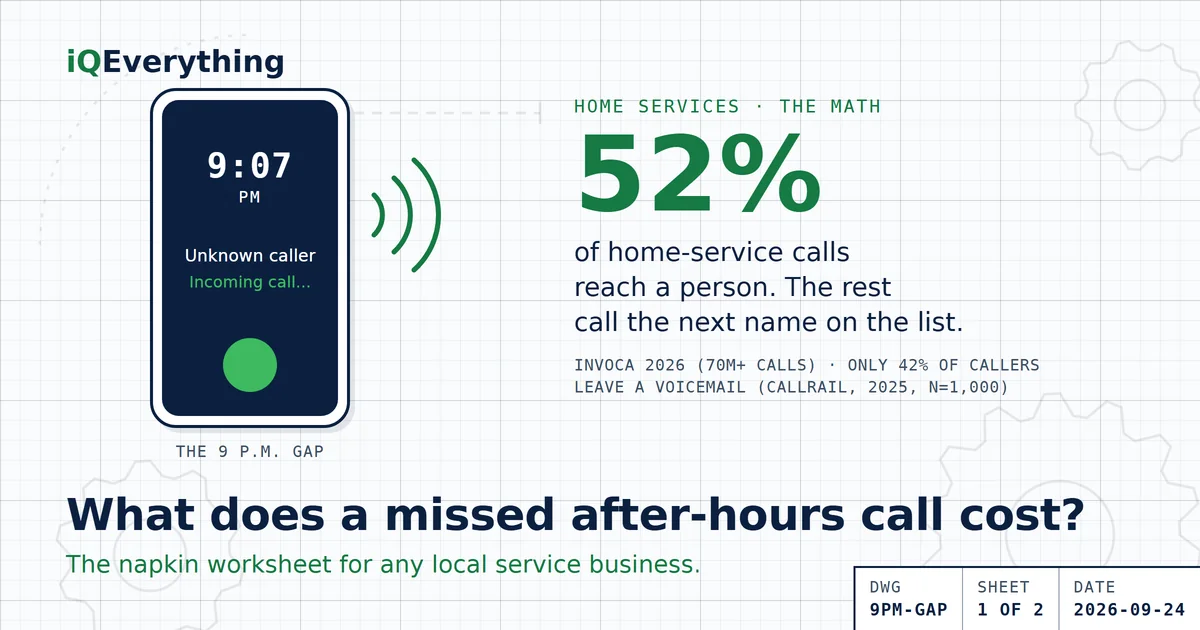
The short answer: about a quarter of a ticket for every call you miss, and a lot more than that after dark. Only 52% of home-service calls reach a person (Invoca, 2026, from more than 70 million calls). When nobody picks up, only 42% of callers leave a voicemail, and 21% immediately call another business (CallRail, 2025 survey of 1,000 US consumers). With a typical plumbing repair at $341 (Angi, 2026) and small shops booking roughly one call in four, a one-truck shop missing eight after-hours calls a week is leaving something like $20,000 a year on the table. Five trucks, five times that.
Below is the worksheet to run your own number, and the cheapest ways to close what I call the 9 p.m. gap.
Picture it. You’re at the ball game. Your kid’s up to bat. The phone buzzes in your pocket and you look down: unknown number, 9:07 p.m. You let it go. You’re a plumber, not a hostage. And that’s fair. You worked a ten-hour day and you earned the ball game.
Here’s the thing, though. That caller has a water heater dumping on the garage floor. She is not going to wait until 8 a.m. to hear back from you. She’s going to hang up, hit the back button, and call the next name on the list. And the next name doesn’t have to be a better plumber than you. He just has to answer.
It’s like leaving the pasture gate open at sundown. You don’t lose the whole herd. You lose the two calves that wander over to the neighbor’s place. And the neighbor didn’t do anything clever. His gate was just shut. You know exactly which neighbor I’m talking about, right?
I call those hours the 9 p.m. Gap: the stretch when your customer is awake, worried, and searching, and your business is dark. Let’s put a dollar figure on yours. Real numbers, named sources, and a worksheet you can do on a napkin.
How many calls actually get missed?
More than anybody likes to admit. Invoca’s 2026 Home Services Lead Conversion Benchmarks report, built on more than 70 million calls across plumbing, HVAC, roofing, and the rest, found that only 52% of calls were answered by a person. Their 2025 report said 55%. So call it half. Half the phone calls to home-service businesses never reach a human being.
What do those callers do next? CallRail asked 1,000 US consumers in September 2025. When nobody answers:
- 42% leave a voicemail. Which means 58% don’t.
- 24% go looking for an online chat instead.
- 21% immediately call another business.
- 82% say they’ll call a competitor if they can’t reach you.
- 78% have already abandoned a business at least once over an unanswered call.
Now, you’ll see scarier numbers floating around the internet. “80% of callers hang up on voicemail.” “85% never call back.” We went looking for where those came from, and the trail goes cold at a vendor blog every single time. The real number is bad enough. Most people who hit your voicemail don’t leave one. You don’t need to inflate it.
Why is the after-hours call the one that hurts?
Because it’s the one you were never going to answer, and it’s the one the customer cares most about. Housecall Pro reported in 2026 that 26% of the jobs booked through its AI call handling come in after hours. One in four. That’s not a rounding error. That’s a quarter of your bookable demand showing up when the lights are off.
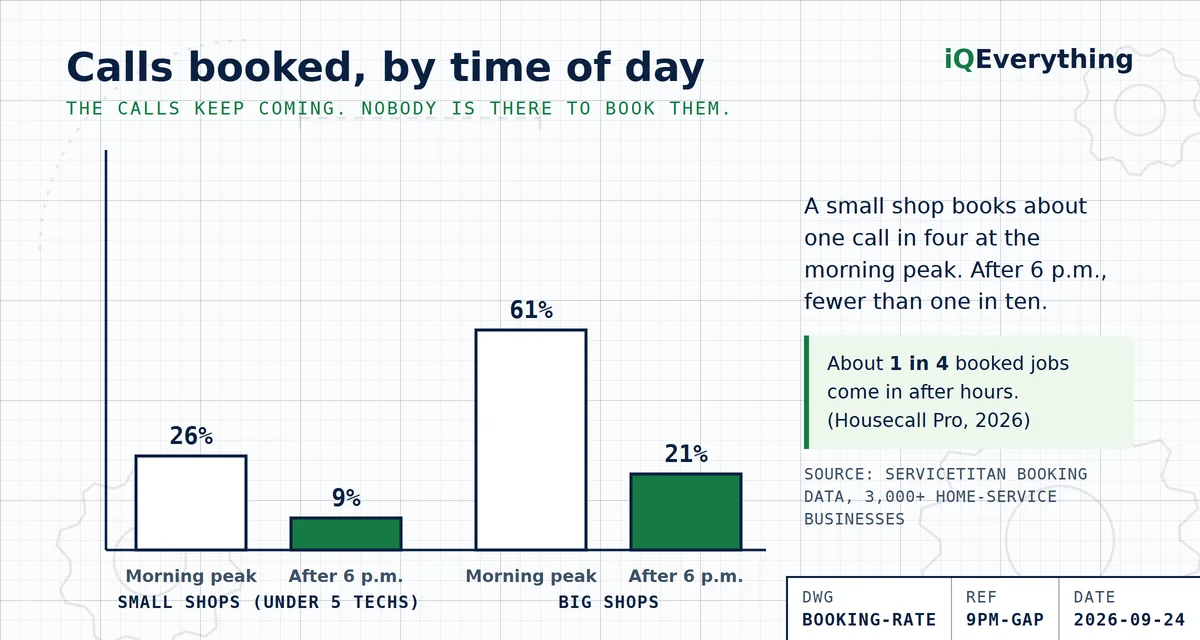
And here’s the part that stings. ServiceTitan pulled booking rates from more than 3,000 home-service businesses. Small shops with fewer than five techs booked about 26% of their calls at the morning peak. After 6 p.m.? 9%. Big shops fell from 61% to 21%. Same phone, same customers, a third of the booking rate. The calls didn’t stop coming in. Nobody was there to book them.
Speed matters even in the daytime. The classic Harvard Business Review study of 2,241 companies found that reaching a new lead within an hour made you about seven times more likely to qualify it than waiting even one more hour. InsideSales’ 2021 refresh across 5.7 million leads found conversion was eight times higher when the first attempt came inside five minutes. Your 9 p.m. caller isn’t getting a reply in five minutes. She’s getting one in eleven hours, if she left a message at all.
What does it cost you? The napkin worksheet
Grab a pencil. Seven lines. Use your own numbers where you have them. Where you don’t, I’ve given you a sourced starting point.
| Line | What to write down | One truck | Five trucks |
|---|---|---|---|
| A | After-hours calls per week (check your phone log; if you don’t know, about one in four of your calls) | 8 | 40 |
| B | Share who don’t leave a voicemail (CallRail: 58%) | 58% | 58% |
| C | Lost contacts per week (A × B) | 4.6 | 23 |
| D | Your normal booking rate (ServiceTitan: 26% for small shops) | 26% | 26% |
| E | Lost jobs per week (C × D) | 1.2 | 6 |
| F | Your average ticket (Angi: $341 plumbing repair) | $341 | $341 |
| G | Lost revenue per year (E × F × 50 weeks) | about $20,000 | about $102,000 |
Two things about that table. First, it’s generous to you. It assumes every single person who left a voicemail was still waiting for you in the morning, and CallRail’s survey says most of them weren’t. Second, it uses a regular repair ticket. The 9 p.m. call is usually the emergency, and Angi puts emergency plumbing at 1.5 to 3 times the normal rate. Run line F at $600 and see what happens to line G.
There are 129,352 plumbing businesses in the United States (IBISWorld, 2026). Most of them are one to five trucks. Most of them are leaving that gate open every night. Are you?
What does the after-hours layer actually have to do?
Three jobs. Not one. This is where most owners buy the wrong fix, so slow down here.
- Answer. The customer has a question. “Do you do tankless?” “Do you come out to Franklin?” “What’s the emergency fee?” If she gets an answer, she stays. If she gets a form, she leaves.
- Book. She wants a slot on your calendar, tonight, without a callback. A real appointment, not a “we’ll reach out.”
- Capture. Name, number, address, what’s wrong, and ideally a photo of the thing. So when you do call at 7:30 a.m., you already know what you’re walking into.
Anything that does one of those three and skips the other two is a patch on a leak. Voicemail captures, sort of, and does nothing else. A contact form captures and does nothing else. Wouldn’t you agree that the customer with water on the floor deserves better than “leave your name and we’ll get back to you”?
What are the options, and what do they cost?
Here’s the honest lineup. Every one of these has a place. None of them does everything.
| Option | Answers questions? | Books the job? | Captures the lead? | Works at 9 p.m.? |
|---|---|---|---|---|
| Voicemail | No | No | Only if they leave one (42% do) | Yes |
| Auto text-back (“Sorry we missed you”) | No | No | Sometimes | Yes |
| Answering service | Basic, from a script | Sometimes, if they have your calendar | Yes | Yes, billed per call or minute |
| Staffed live chat | Yes | Yes | Yes | Only while somebody is staffing it |
| AI chat widget trained on your website | Yes, from your own content only | Yes, into your real calendar | Yes, with photos | Yes, flat monthly rate |
Notice the widget row. It only does all three jobs if it’s trained on your website and nothing else, so it can’t promise a customer something you don’t do. And it only works if it books into your actual calendar, not a fake one that emails you. A chatbot that makes things up is worse than voicemail. We wrote a whole post on why the bot should only know what’s on your website, and I’d read it before you buy anything.
Do customers even want to talk to a machine at 9 p.m.? Housecall Pro surveyed 1,040 US homeowners in 2025. 97% said a fast response influences who they hire. More than half were comfortable with AI handling first contact, and 52% said after-hours AI is a sign of better service, not worse. The customer isn’t picky about who answers. She’s picky about whether anybody does.
How do you close the 9 p.m. gap this week?
Three steps, in order. Don’t skip the first one just because it’s boring.
Step 1: Pull your own phone log
Most phone systems will show you calls by hour. Count the ones after 6 p.m. and before 8 a.m. for the last two weeks. That’s your line A, and it’s the number that makes this real instead of a blog post. If it’s two calls a week, an auto text-back might be plenty. If it’s twenty, keep reading.
Step 2: Cover all three jobs, not one
Answer, book, capture. Whatever you pick has to do all three, or you’re still leaking. For most shops that means one thing to catch the phone and one thing to catch the website, because the 9 p.m. customer is as likely to be searching as dialing. CallRail’s survey found 24% of unanswered callers go straight to online chat. If your website can’t answer at 9 p.m., that’s a second gate you left open.
Step 3: Pick the cheapest thing that does all three, then measure
Run it for 30 days. Count the after-hours bookings. Compare that to line G. If it isn’t paying for itself several times over by day 30, turn it off. That’s the whole test. The right tool is the one that costs less than the calls it catches.
Frequently asked questions
What does a missed call cost a plumbing or HVAC business?
Roughly one average ticket for every three or four calls you miss, and more after hours. Angi’s 2026 cost guides put a typical plumbing repair at $341 and an HVAC repair at $350, with emergency calls at 1.5 to 3 times that. ServiceTitan’s data shows small shops book about 26% of calls at the morning peak, so each missed call is worth about a quarter of a ticket. A one-truck shop missing eight after-hours calls a week can be leaving around $20,000 a year on the table.
How many calls to home-service businesses go unanswered?
About half. Invoca’s 2026 Home Services benchmarks, built on more than 70 million calls, found only 52% of calls are answered by a person. CallRail’s 2025 survey of 1,000 US consumers found only 42% of callers leave a voicemail when nobody answers, 21% immediately call another business, and 78% have abandoned a business over an unanswered call.
How many home-service jobs come in after business hours?
About one in four. Housecall Pro reported in 2026 that 26% of jobs booked through its AI call handling come in after hours. ServiceTitan’s booking data shows why those calls get lost: small shops book about 26% of calls at the morning peak but only 9% after 6 p.m.
Is an answering service or an AI chat widget better for after-hours calls?
They cover different customers. An answering service catches the caller and can take a message, but usually can’t answer questions about your work or book into your calendar. An AI chat widget trained only on your website answers questions, books appointments, and captures the lead for the visitor who is searching your site at 9 p.m. instead of dialing. Many shops end up wanting both.
Do customers mind talking to AI after hours?
Less than owners expect. Housecall Pro’s 2025 survey of 1,040 US homeowners found 97% say a fast response influences who they hire, more than half are comfortable with AI handling first contact, and 52% see after-hours AI as a sign of better service. The condition is honesty: the AI says what it is and hands off to a person when it doesn’t know.
Two ways to shut the gate
Full disclosure: we built one of the tools in that table, because our own clients kept asking for it and everything on the market either made things up or charged by the conversation. So here are both doors. Pick whichever fits.
Door 1: Put a chat widget on your site that only knows your business
The Best AI Chat Widget is trained only on your website, books real appointments into your Google Calendar, reads the photo the customer uploads of the leak, and hands off to a human with the full transcript when it doesn’t know. We set it up for you. Flat monthly rate, no per-conversation fees. The first 50 shops get it for $1 for 30 days, then $47 a month. That first month is the 30-day test from step 3: count the after-hours bookings against line G and keep it only if it pays.
Door 2: Talk through your whole phone-and-website setup first
If you’re not sure whether the leak is the phone, the website, or the scheduling behind both, bring your phone log to a strategy call. We’ll run the worksheet with you and tell you the cheapest fix, even if it’s not ours.
Want us to run your number?
Bring two weeks of your phone log. We’ll fill in the worksheet with you, line by line, and tell you what’s worth fixing first. Plain English, your numbers.
Book a Strategy CallOr call or text (615) 628-7386. A human answers. Yes, even at 9 p.m.