Home › Blog › ADA Website Law 2027
The State of ADA Website Law Going Into 2027
Last updated: October 6, 2026
Almost nobody in government is policing business websites for accessibility, so a small group of private law firms does it instead, one lawsuit at a time. In 2025 they filed somewhere between 3,117 and 5,114 website / digital suits, depending on who is counting. Five firms filed about 60% of the ones EcomBack tracked. One consultant who follows these cases puts the usual settlement at $5,000 to $20,000, and paying does not stop the next one. The only thing that reliably ends a case is a website that is actually fixed, with dated proof.
National U.S. briefing for business owners. Research, not legal advice.
Read this first: what I could and could not prove
I set out to write the full story on ADA website lawsuits. It turned out to be a lot harder than I thought to get accurate information.
Nobody keeps an official count of these suits. Almost every settlement is confidential. Demand letters are private. Most numbers floating around come from companies with something to sell.
Rule for this paper: if I could not check it at the source, it is not in here.
- When a number comes from one company's report, I tell you whose report.
- When I looked and found nothing, I say so.
- My own guesses and dollar totals for “the industry” are out.
That makes this paper lighter on scary numbers than most of what you will read. Good.
One request. If you have verifiable information that belongs in here, please send it. A demand letter you received, a court filing, a settlement you are free to share, a data set, or a correction. Send it through the contact page, or text (615) 628-7386. I will check it and update the paper.
The 60-second version
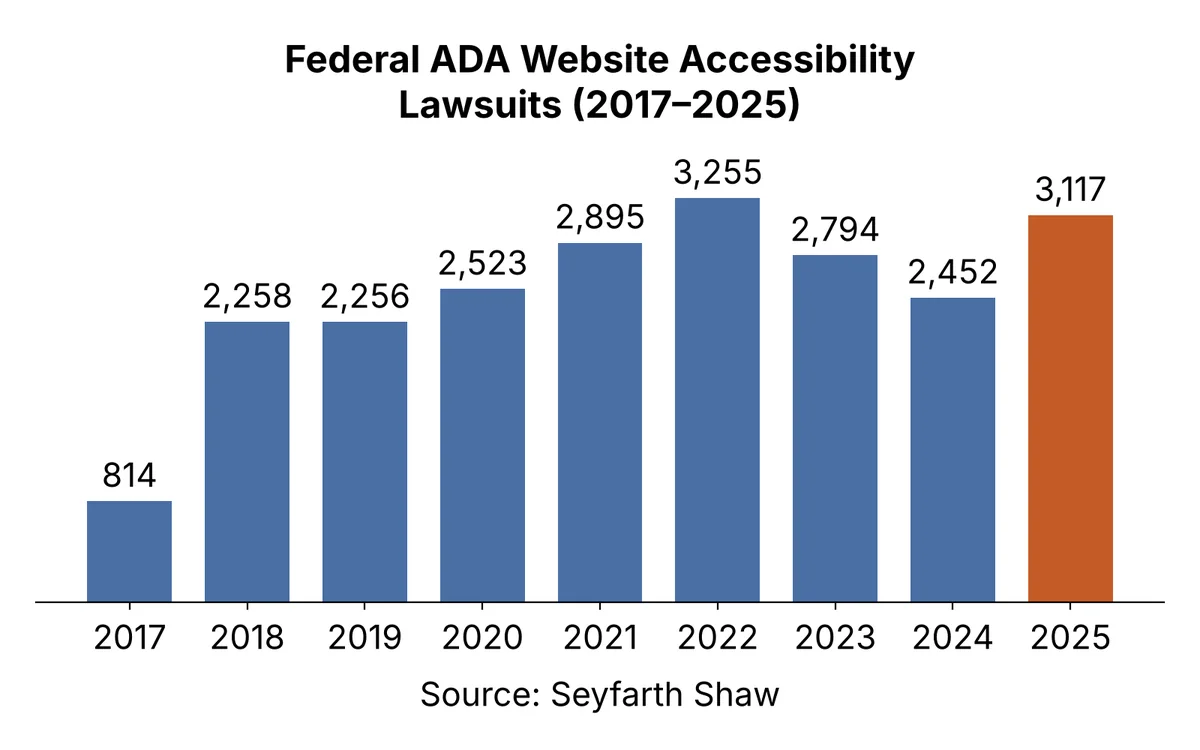
- The lawsuits are back up. Federal website suits jumped 27% in 2025, to 3,117 (Seyfarth Shaw). Add state courts and the count is 3,948 (EcomBack) or 5,114 (UsableNet).
- Five firms file most of them. Top five ≈ 60% of EcomBack’s 2025 track; ≈ 65% in H1 2026.
- A small set of people are the plaintiffs in a huge share of cases. EcomBack: about 30 people were plaintiffs in half of H1 2026 suits.
- Small and mid-size businesses carry the load. UsableNet: about 2 in 3 sued companies under $25M revenue.
- Settlement range (consultant): $5,000–$20,000. Almost all settlements are confidential.
- Paying does not buy peace. UsableNet: 1,427 suits in 2025 against companies already sued before.
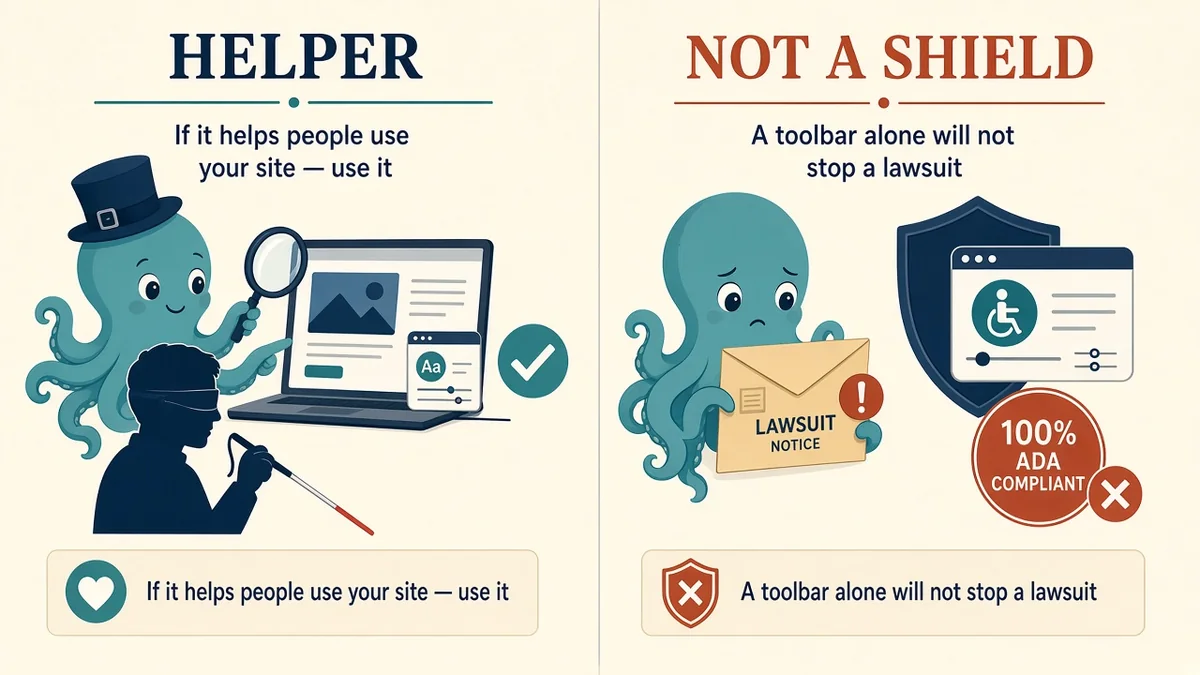
- Widgets: about 1 in 4 sued sites had a widget; about 3 in 4 did not (EcomBack). A widget alone is not a shield, and if it truly helps people use your site, it can still be worth having.
- Washington has stepped back on private sites. No Title III federal tech rulebook. Feb 2026 DOJ filing: U.S. “does not endorse WCAG” as the Title III standard.
- Four states let businesses push back: Kansas, Utah, Georgia, Missouri.
- 95.9% of top home pages fail a basic scan (WebAIM Million 2026).
- What works: find it, fix the code, keep dated proof.
I am a marketing guy, not an attorney. If a letter lands, call a lawyer who does this work before you answer.
A pasture with no rulebook
The ADA passed in 1990. Title III covers places of public accommodation. It never mentions websites.
- DOJ started business-website rules in 2010, withdrew them in 2017. I found nothing on the 2026 agenda that brings them back for private shops.
- Supreme Court has not settled whether websites are covered.
- Appeals courts disagree: some require a tie to a brick-and-mortar place; others say a website alone can count.
Into that hole fell WCAG (Web Content Accessibility Guidelines) from the W3C. No federal rule makes ordinary private businesses follow it. Lawyers, courts, and settlements still reach for WCAG 2.1 Level AA.
Under federal Title III, a private plaintiff generally cannot win money damages. They can win an order to fix the site plus attorney’s fees. California’s Unruh Act and New York laws add damages. Guess where a lot of suits get filed.
More than 1 in 4 American adults, over 70 million people, live with a disability (CDC). Real barriers are real. The enforcement model is a mess. Both can be true.
The numbers: three scorekeepers, three scores
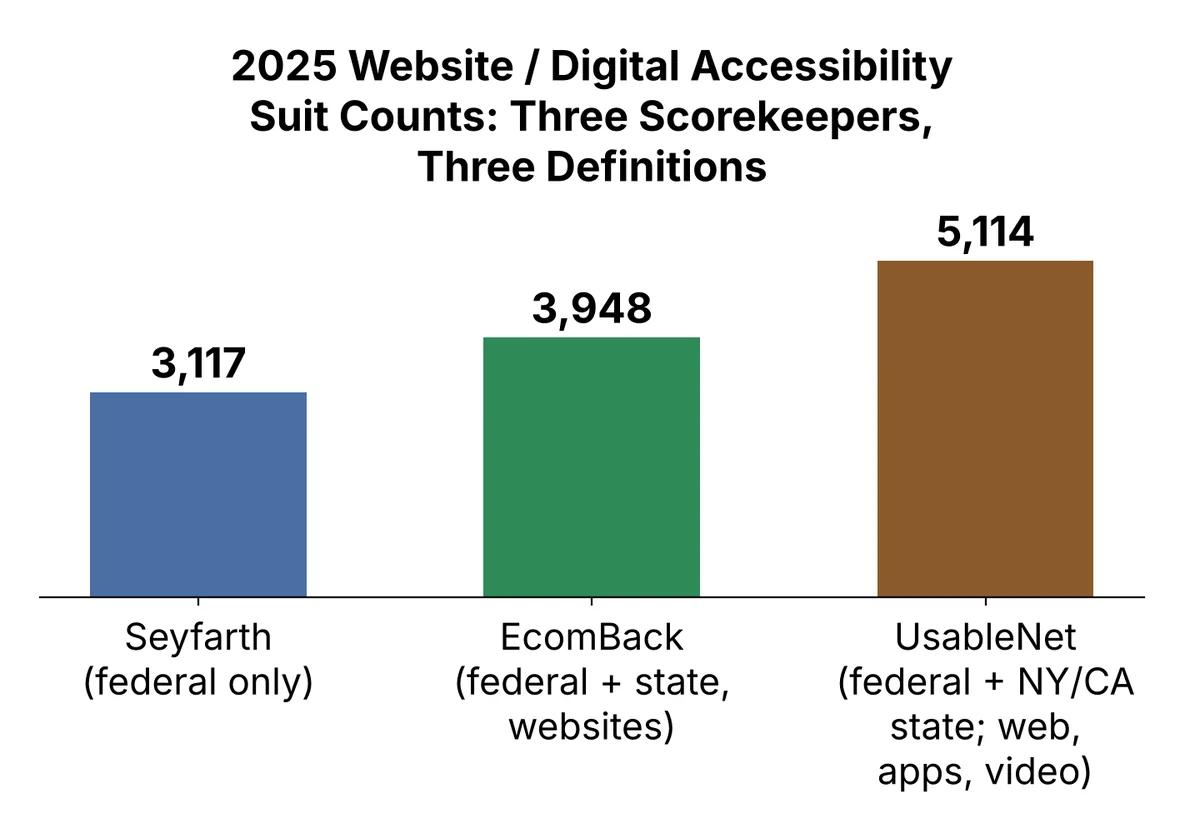
| Scorekeeper | Who they are | What they count | 2024 | 2025 | 2026 so far |
|---|---|---|---|---|---|
| Seyfarth Shaw | Defense-side law firm | Federal court only, websites | 2,452 | 3,117 (+27%) | No website-only count published yet |
| EcomBack | Accessibility vendor | Federal + state, websites | 3,188 | 3,948 (+24%) | 2,045 Jan–Jun; 2,586 through Aug |
| UsableNet | Accessibility vendor | Federal + NY/CA state; websites, apps, video | “4,000+” | 5,114 | On pace ~6,176 |
Federal website suits by year (Seyfarth Shaw), the same numbers as the first chart:
| Year | 2017 | 2018 | 2019 | 2020 | 2021 | 2022 | 2023 | 2024 | 2025 |
|---|---|---|---|---|---|---|---|---|---|
| Federal website suits | 814 | 2,258 | 2,256 | 2,523 | 2,895 | 3,255 | 2,794 | 2,452 | 3,117 |
Federal website suits nearly tripled from 2017 (814) to 2018 (2,258), peaked at 3,255 in 2022, dipped, then roared back in 2025. Seyfarth’s line: these cases are “very easy for plaintiffs to file because they don't even need to leave their homes.”
All Title III (ramps included): Seyfarth counted 8,667 federal filings in 2025; websites were 36% of that (up from 28%).
Nobody has published a clean 2027 forecast. I am not inventing one.
Where the suits get filed
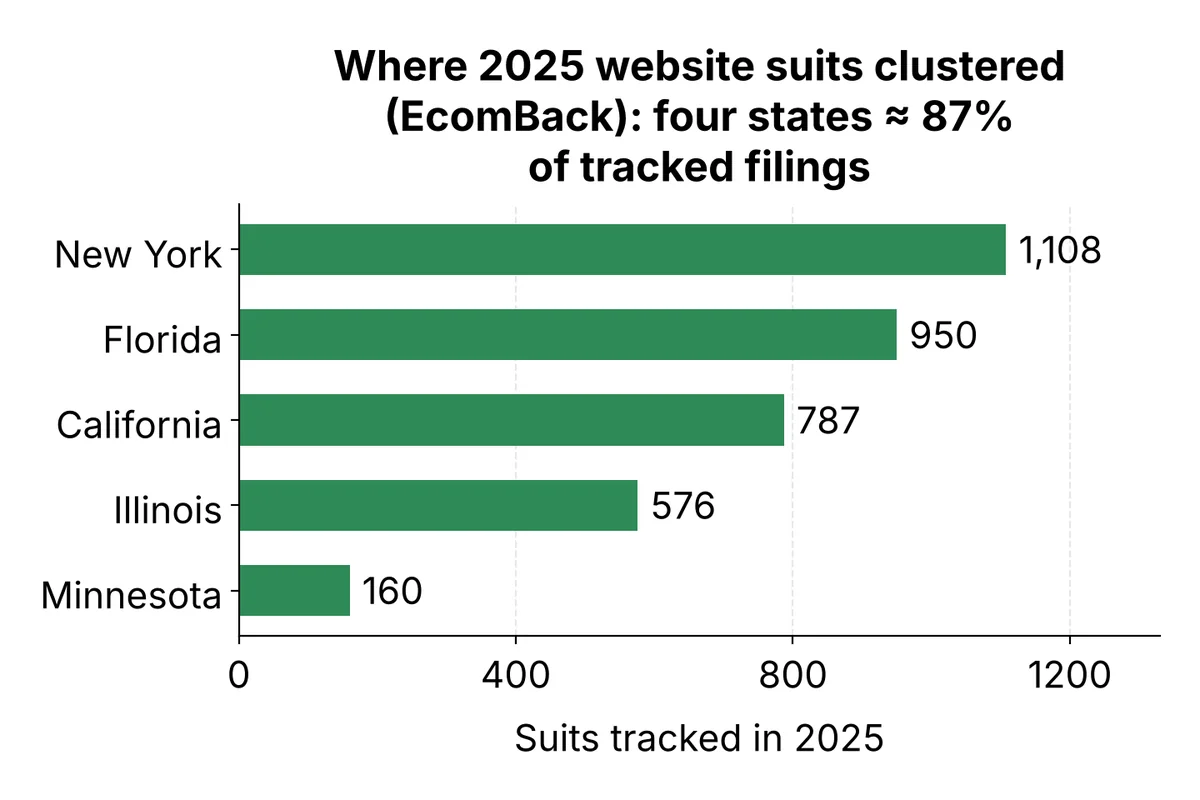
| State | 2025 suits | Jan–Jun 2026 | What’s going on |
|---|---|---|---|
| New York | 1,108 | 399 | Migration toward state court after federal judges got stricter |
| Florida | 950 | 333 | Mostly federal |
| California | 787 | 424 | Mostly state court (Unruh $4,000 minimum) |
| Illinois | 576 | 463 | Exploded from 92 in 2024; #1 in early 2026 |
| Minnesota | 160 | 120 | Highly concentrated in one firm |
Source: EcomBack 2025 annual + 2026 mid-year.
These numbers show where lawyers file, not where your business lives. If you sell online, you can still get named from a couch in Chicago, Brooklyn, Miami, or Los Angeles.
Who gets sued
By size
UsableNet (2025): 64% of sued companies under $25M revenue (down from 73% in 2023). True mom-and-pop share is unknown, that bucket is wide.
By industry (EcomBack, H1 2026)
- Restaurants / food / drink: 29%
- Fashion / apparel: 28%
- Health / beauty / wellness: 15%
- Home / furniture / garden: 10%
UsableNet: ~70% of 2025 suits hit e-commerce; 35.8% of the 500 biggest online retailers were sued at least once.
Local service businesses (HVAC, cleaners, etc.) are usually buried in “other.” Anybody quoting a precise share is guessing.
By platform (EcomBack)
| Platform | Share of 2025 suits | Share Jan–Jun 2026 |
|---|---|---|
| Shopify | 33% | 47% |
| Custom-coded | 35% | 32% |
| WordPress | 20% | 13% |
This shows where suits land, not which platform is “riskiest.” Shopify has a lot of stores. WooCommerce is lumped into WordPress in these counts.
Getting sued once does not clear you
1,427 suits in 2025 hit companies already sued before (UsableNet), about 45% of its federal cases.
Accessibility widgets: play both sides
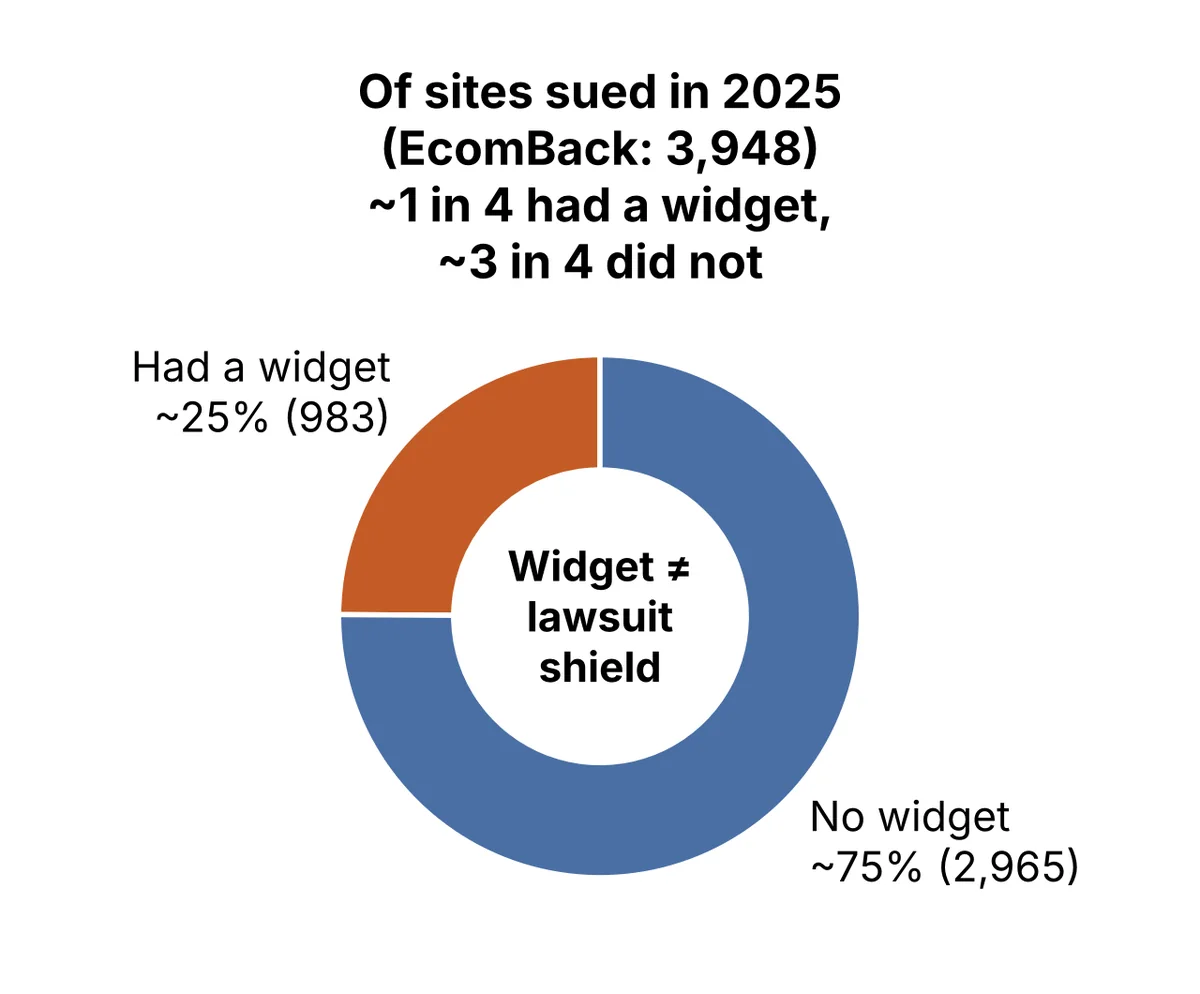
EcomBack: 983 of 3,948 sued sites in 2025 (24.9%) already had an accessibility widget. Flip it: about 75% did not.
What that does and does not prove - Does not prove widgets attract lawsuits. Scared businesses may be the ones buying them. Scorekeepers often compete with widget makers. - Does prove a widget alone did not stop the suit when one was filed. - Only ~2% of all websites use one (Web Almanac 2025), so widgets are over-represented among sued sites relative to the whole web, which is interesting but still not causation.
FTC: accessiBe ordered to pay $1 million (Apr 2025) and barred from unsupported “this makes you compliant” claims. Overlay Fact Sheet: signed by ~1,000 accessibility pros saying overlays cannot fully eliminate legal risk.
Fair take for owners: If a widget actually helps people with disabilities use your site, read the menu, fill the form, check out, use it. That is more revenue and the right thing to do. Test it with real users first, screen reader users included. Disability rights lawyer Lainey Feingold warns about “quick fix solutions like overlays that harm disabled people and don't protect against lawsuits.” Just know it is not a 100% lawsuit shield. Code-level fixes + dated proof are still the foundation. Helper: yes. Magic armor: no.
The five firms (EcomBack)
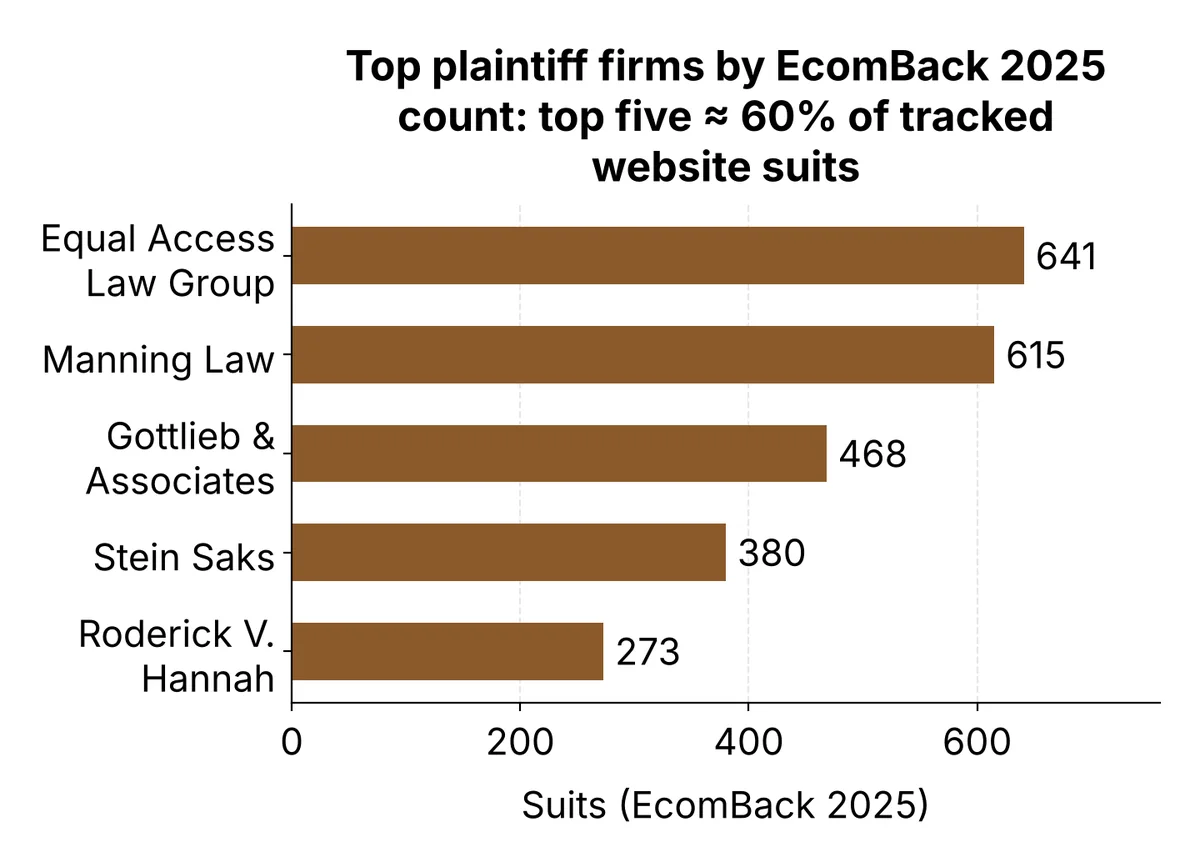
| Firm | 2025 suits (share) | Jan–Jun 2026 (share) |
|---|---|---|
| Equal Access Law Group | 641 (16%) | 526 (26%) |
| Manning Law | 615 (16%) | 366 (18%) |
| Gottlieb & Associates | 468 (12%) | 197 (10%) |
| Stein Saks | 380 (10%) | 124 (6%) |
| Roderick V. Hannah | 273 (7%) | 67 (3%) |
| Throndset Michenfelder | 158 (4%) | 120 (6%) |
| Top five combined | ~2,377 (60%) | ~1,333 (65%) |
Six names because #5 changed hands. Filing a lot of lawsuits is legal. UsableNet ranks Mizrahi Kroub #1 in its own count, different courts, different lists. Attribute the scorekeeper.
H1 2026 (EcomBack): 30 people were plaintiffs in 1,035 suits (half of filings). All 2,045 cases came from 225 people.
What the letter and the lawsuit look like
Demand letters are private, nobody has a real count.
One sample California letter, published by a defense firm: cites ADA + Unruh; claims WCAG failures; cites $4,000 per instance; gives 21 days; attaches a draft complaint. Another defense firm says 10 to 30 days is common.
What a private plaintiff can win
| Law | What they can win |
|---|---|
| Federal ADA Title III | Injunction to fix + attorney’s fees. No money damages. |
| California Unruh Act | That + at least $4,000 per violation |
| New York State / City Human Rights Law | Compensatory (and NYC: punitive) damages too |
What it costs
| Path | Typical money talk | What you have after |
|---|---|---|
| Fix first | ~$1,500–$7,500 audit+repairs for many small sites (Accessible.org, vendor pricing) | Working site + dated proof + more customers who can buy |
| Get sued first | Consultant settlement range $5k–$20k + your own lawyer | Still owe a fix; next plaintiff is free to sue |
Fighting can cost far more than settling. Two owners told reporters what it cost them: about $46,000 in legal fees after a $4,950 deal fell apart (21 Hats), and about $200,000 all-in across three suits (Boston 25 News). One defense lawyer says the demands are “priced at less than it would cost to respond to the complaint.” That is his view, and he is on one side of these cases.
A settlement with one plaintiff does not bar a different plaintiff from suing over the same site.
Fashion Nova (2026): proposed ~$2.43M to class / ~$2.52M to lawyers; DOJ opposed the deal as fee-heavy with weak accessibility relief. Status: check before you cite as final.
What they go after
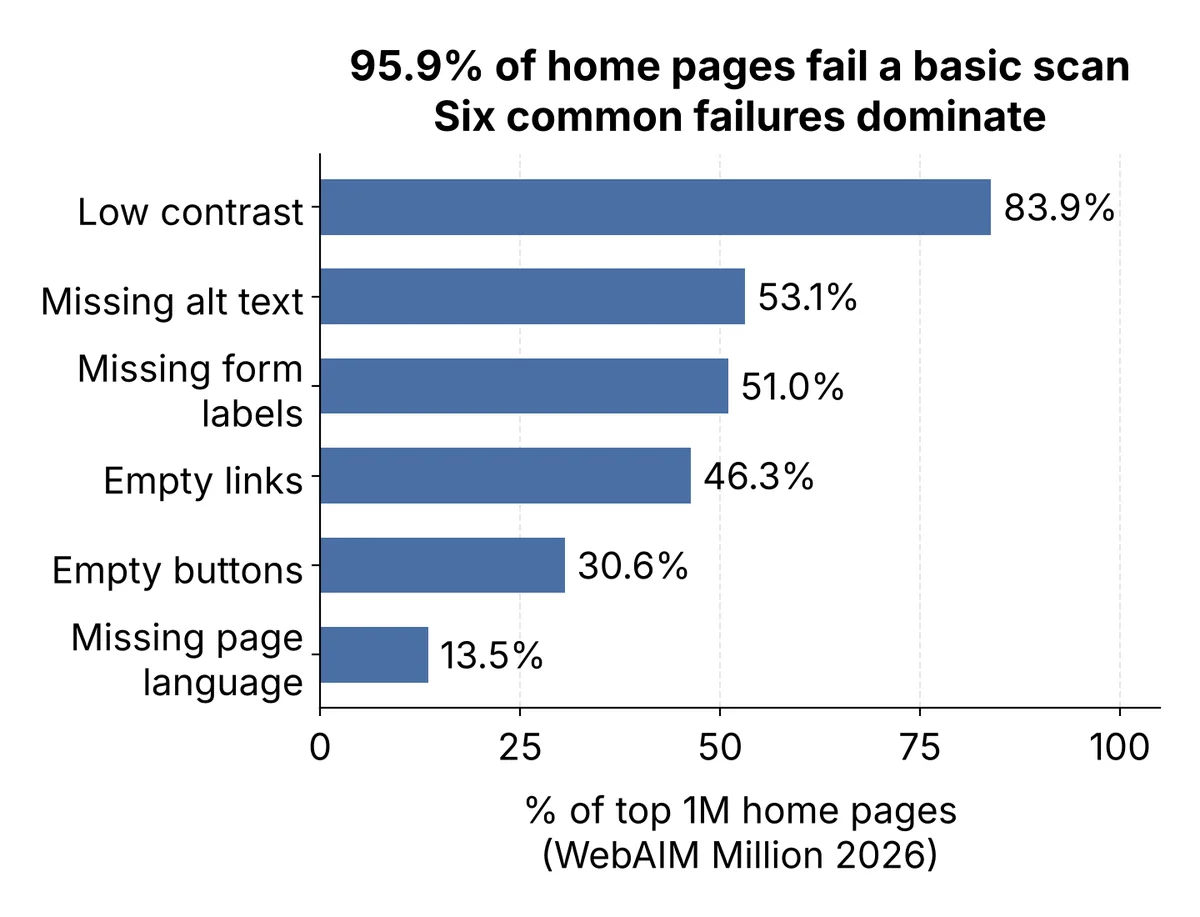
WebAIM Million Feb 2026: detectable failures on 95.9% of top 1M home pages; average ~56 errors/page.
| Problem | Plain English | Share of home pages (2026) |
|---|---|---|
| Low contrast text | Light gray on white | 83.9% |
| Missing alt text | Picture with no description | 53.1% |
| Missing form labels | Box with no name | 51.0% |
| Empty links | Link with no name | 46.3% |
| Empty buttons | Button with no name | 30.6% |
| Missing page language | Screen reader doesn’t know the language | 13.5% |
Complaint hit list is nearly the same: alt text, forms/checkout, keyboard access, focus markers, contrast, labels/structure, heading order, inaccessible PDFs. Third-party bolt-ons (cookies, pop-ups, chat, ordering widgets) show up as risk in vendor writeups, test them like they are your site.
AI-built sites: AudioEye’s Sept 2026 vendor test found AI-built demo sites failing basic accessibility even when told to comply. Peer-reviewed work finds AI often fails first pass and improves with human pushback. Let AI draft; have a person check.
Washington: no private-site rulebook
Title III (private businesses): still no binding federal WCAG rule. DOJ’s 2022 web guidance says WCAG is “helpful,” not required. In its Fashion Nova filing, the U.S. said it does not endorse WCAG as the necessary Title III standard.
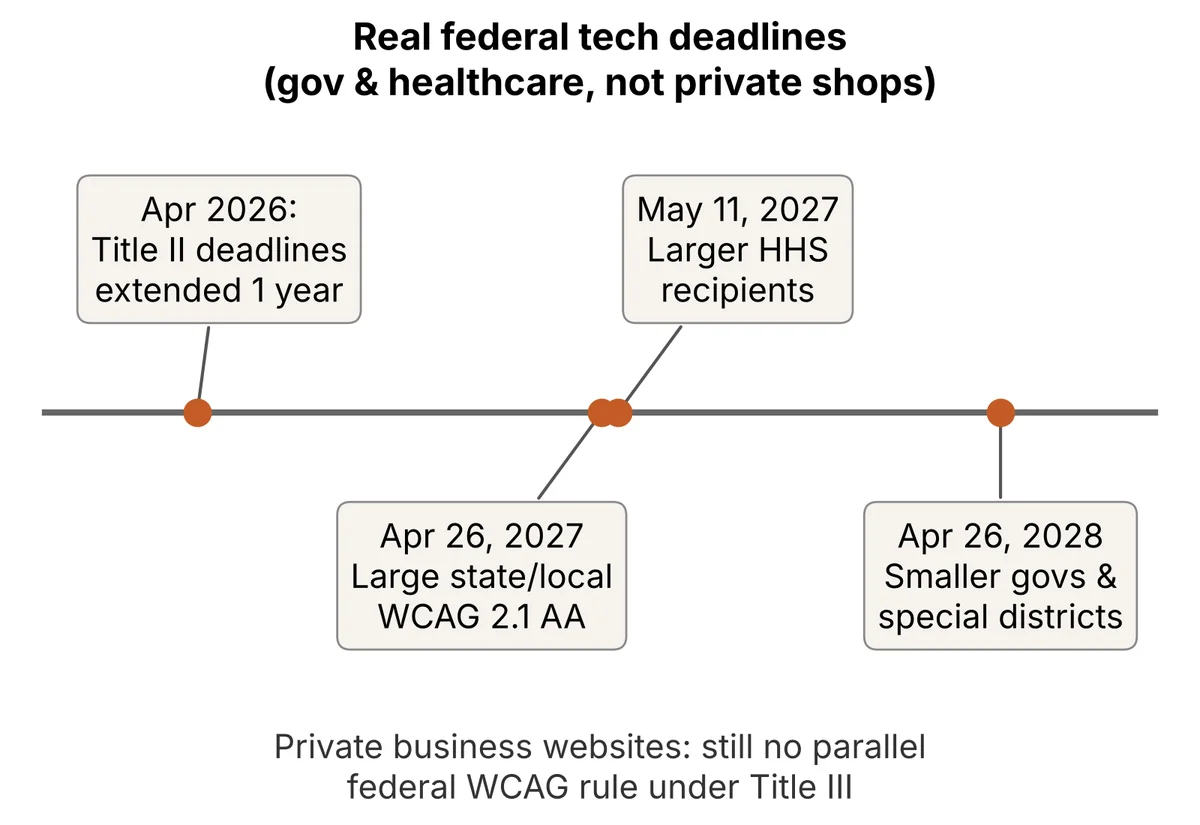
Title II / HHS 504 (government & many healthcare providers): real WCAG 2.1 AA rules, deadlines extended in spring 2026:
| Rule | Who | Old deadline | Deadline now |
|---|---|---|---|
| DOJ ADA Title II | State/local govs ≥50,000 | Apr 24, 2026 | Apr 26, 2027 |
| DOJ ADA Title II | Smaller govs / special districts | Apr 26, 2027 | Apr 26, 2028 |
| HHS Section 504 | Recipients ≥15 employees | May 11, 2026 | May 11, 2027 |
| HHS Section 504 | Fewer than 15 employees | May 10, 2027 | May 10, 2028 |
NFB sued over the delays (May 2026). Don’t carve dates in stone until courts and further rulemaking settle.
Congress: notice-and-cure / standards bills floating; as of research close Oct 5, 2026, none had become law. This Congress ends Jan 3, 2027.
Four states that let businesses push back
| State | Law | In effect | Protection idea |
|---|---|---|---|
| Kansas | K.S.A. 60-5005 | Jul 1, 2023 | Good-faith fixes after notice |
| Utah | SB 68 | May 6, 2026 | Start fix in 30 days / finish in 90 |
| Georgia | HB 1470 / Act 458 | Jul 1, 2026 | Loser-pays style after plaintiff loses / dismissed |
| Missouri | SB 907 | Aug 28, 2026 | Substantial corrective steps within 90 days of notice |
These punish abusive filers. They do not excuse a broken site. They mainly help when your state’s courts can reach the filer. In May 2026, Seyfarth wrote that it could not find any suit filed under the Kansas law. I found none under the other three.
What actually works
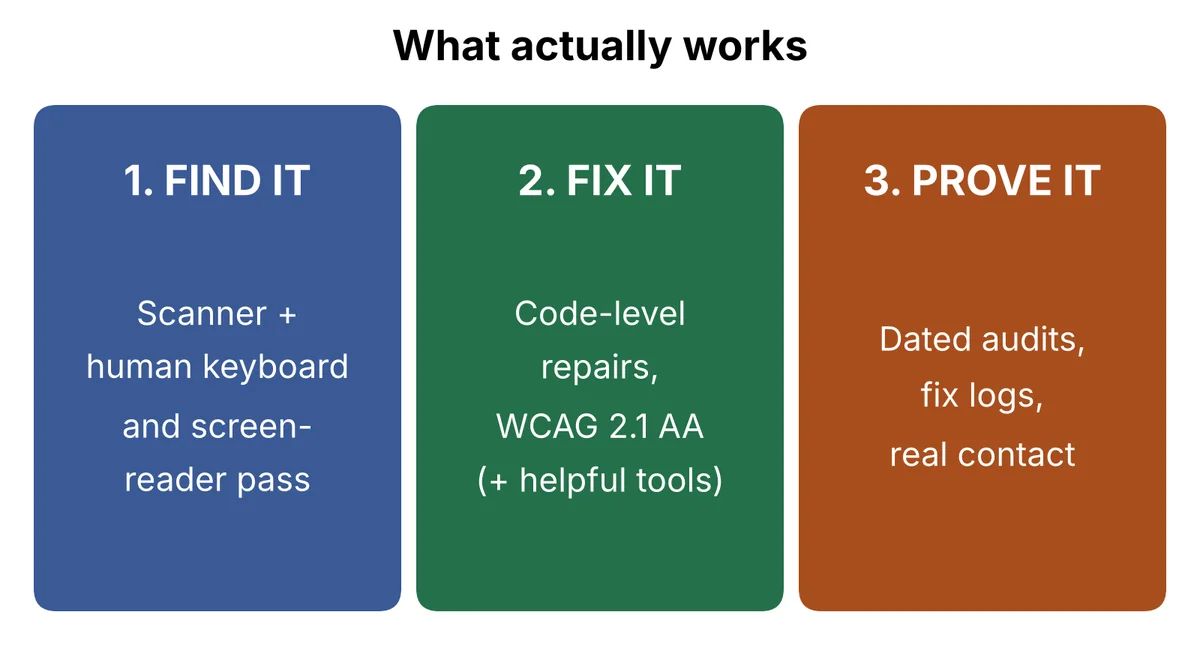
- Find it, scanner + human keyboard and screen-reader pass on money paths; test pop-ups, cookies, chat, ordering widgets.
- Fix it in the code, WCAG 2.1 AA working benchmark (2.2 AA on new builds). Add helpful tools on top if they improve real access.
- Prove it, dated audit reports, fix logs, accessibility statement with a real contact, vendor contracts that include accessibility.
What does not work alone
- A widget as your only defense
- A scan with no human pass
- Paying without fixing
- Trusting AI output untested
- An accessibility statement with no work behind it
If a letter shows up
- Don’t ignore it.
- Don’t fire off a reply.
- Keep everything.
- Call a lawyer who handles these cases.
- Ask your insurer.
- Start the audit/fixes the same day, date everything.
What to watch in 2027
| When | What | Why it matters |
|---|---|---|
| Jan 3, 2027 | Congress ends | Pending bills die unless passed |
| TBD | Fashion Nova settlement ruling | Fee-heavy class deals vs real accessibility relief |
| TBD | NFB suit on delayed gov rules | Could snap deadlines back |
| Apr 26, 2027 | Large state/local Title II | WCAG 2.1 AA if deadline holds |
| May 11, 2027 | Larger HHS 504 recipients | Same standard |
| Spring 2027 | State sessions | More sue-back laws? |
| All year | Filing geography | Watch where boats trailer next |
Bottom line
You did not build your website to keep anybody out. But right now private enforcement fills a hole Congress and DOJ left open for business sites.
Find the problems. Fix them in the code. Keep dated proof. Use tools that truly help people, including a widget if it earns its keep for real users, without pretending any toolbar is a force field.
When you do it right, more of those 70+ million adults with disabilities can do business with you. That is the point of the law underneath the noise: good operators keep their money, and more people get in the door.
If you want a second set of eyes on a site, that is the kind of work we do at iQEverything.
— Andrew Easy Anderson
FAQ
Is there a federal WCAG rule for ordinary business websites?
No. Title III has no binding federal tech standard for private sites. WCAG is still the yardstick plaintiffs and many settlements use.
Did DOJ say WCAG doesn’t matter?
DOJ said it does not endorse WCAG as the necessary Title III standard (Fashion Nova SOI, Feb 2026). Plaintiffs still plead WCAG. You are still in the middle.
Do accessibility widgets stop lawsuits?
Not by themselves. ~1 in 4 sued sites already had one; ~3 in 4 did not. If testing with real users shows a widget helps them, use it. Don’t buy it as armor alone.
What’s the usual settlement?
Consultant range often cited: $5,000–$20,000. Nearly all deals are confidential, treat it as a band, not a measured average.
What should I do before anyone sues?
Audit (machine + human), fix code on critical paths, keep dated proof, give customers a real accessibility contact.
Sources (main)
- Seyfarth Shaw ADA Title III blog (2025–2026 filing reports)
- EcomBack 2025 annual + 2026 mid-year lawsuit reports
- UsableNet 2025 year-end + 2026 trend posts
- WebAIM Million 2026
- DOJ OPA / Fashion Nova Statement of Interest (Feb 2, 2026)
- Federal Register Title II / HHS 504 deadline extensions (Apr–May 2026)
- FTC accessiBe final order (Apr 2025)
- Overlay Fact Sheet · Accessible.org · CDC disability prevalence
Version: v2.02 national visual pack · Research closed Oct 5, 2026 · Not legal advice.
Want a second set of eyes on your site?
Bring your website to a strategy call. We will walk the money paths with you, show you what a scan sees first, and tell you what to fix and what proof to keep. Plain English. Not legal advice.
Book a Strategy CallOr call or text (615) 628-7386. A human answers.