Home › Blog › Is Glamping Actually Profitable
Is Glamping Actually Profitable? How to Let Data Pick Your Next Business Before Your Gut Does
Last updated: August 9, 2026
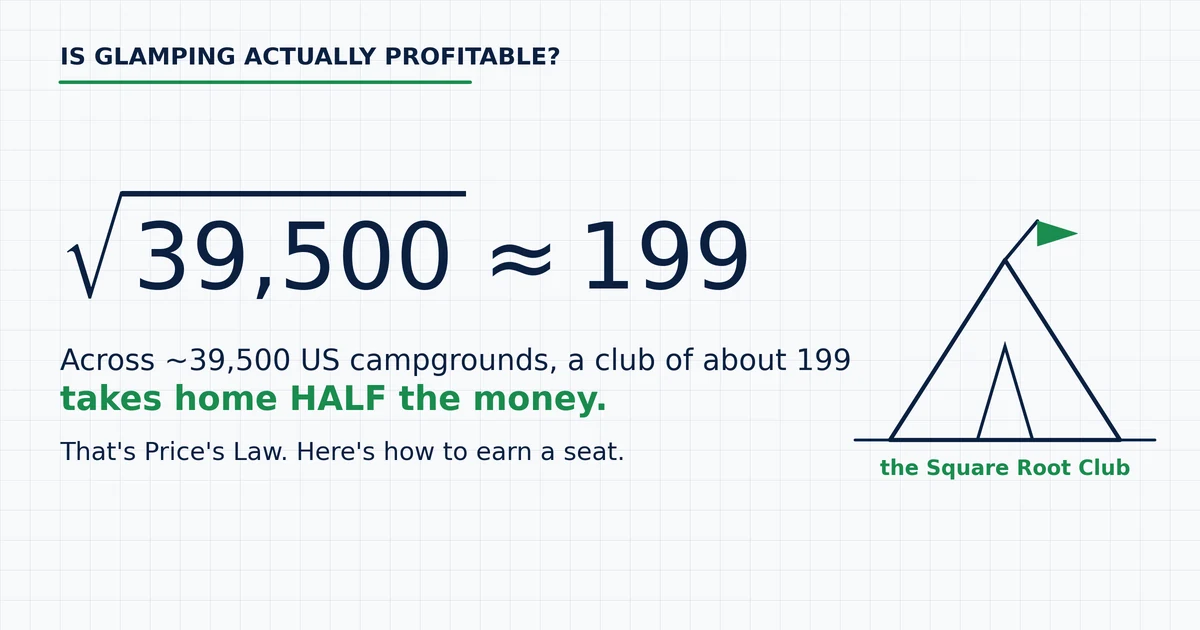
The short answer: for a small club, wildly. For most, barely. Hipcamp’s database covers roughly 39,500 campgrounds across the US, yet the advisory firm Sage Outdoor Advisory estimates only 300 to 500 glamping operations are professionally managed, and the top 7 brands hold about 100 of those locations. That pyramid is Price’s Law at work: in almost any market, roughly the square root of the players take home half the money.
The way into the small club is not luck, and it sure isn’t gut feel. It is data: finding out what the quiet winners actually do, then building an operation that runs on systems instead of your personal hustle.
I just got off the phone with a client working through exactly this. Not a startup dreamer, an established owner with an operation that already works, asking the five-year question: where do we put the next dollar so profit goes up AND the phone stops ringing at dinner? No names and no numbers here, because that’s their business. But the shape of the conversation is one I have every week, and it always comes down to the same fork in the road: gut or data.
Most folks take the gut road. Here’s the better way.
Why do most people pick their next business with their gut?
Because the idea is fun to fall in love with. Glamping looks like a magazine spread. Farm-to-table dinners sound meaningful. A petting zoo? Come on, who doesn’t smile at a petting zoo? :)
So people build first and find out later whether the market was ever there. That’s like buying a bull at auction because he’s got a handsome face, without ever looking at his papers. You find out what you really bought about a year later, and by then the check has long since cleared.
Romance picks the idea. Data should pick the market. The good news is the answer to “will this pay?” already exists before you spend a dime. You just have to know where it hides, and who’s hiding it. More on that in a minute.
What is Price’s Law, and why does it change everything?
Price’s Law comes from Derek J. de Solla Price, a historian of science. He studied who actually writes the papers in any scientific field, and he found something uncomfortable: roughly the square root of the contributors produce half the output. A handful do half the work. Everybody else splits the rest.
Now look at glamping through that lens, with real numbers. Hipcamp’s database covers roughly 39,500 campgrounds across the US. The square root of 39,500 is about 199. So Price’s Law says a club of about 199 operators, half of one percent of the market, takes home half the money. The other 39,000-and-change divide what’s left, and plenty of them are barely covering the cost of the canvas.
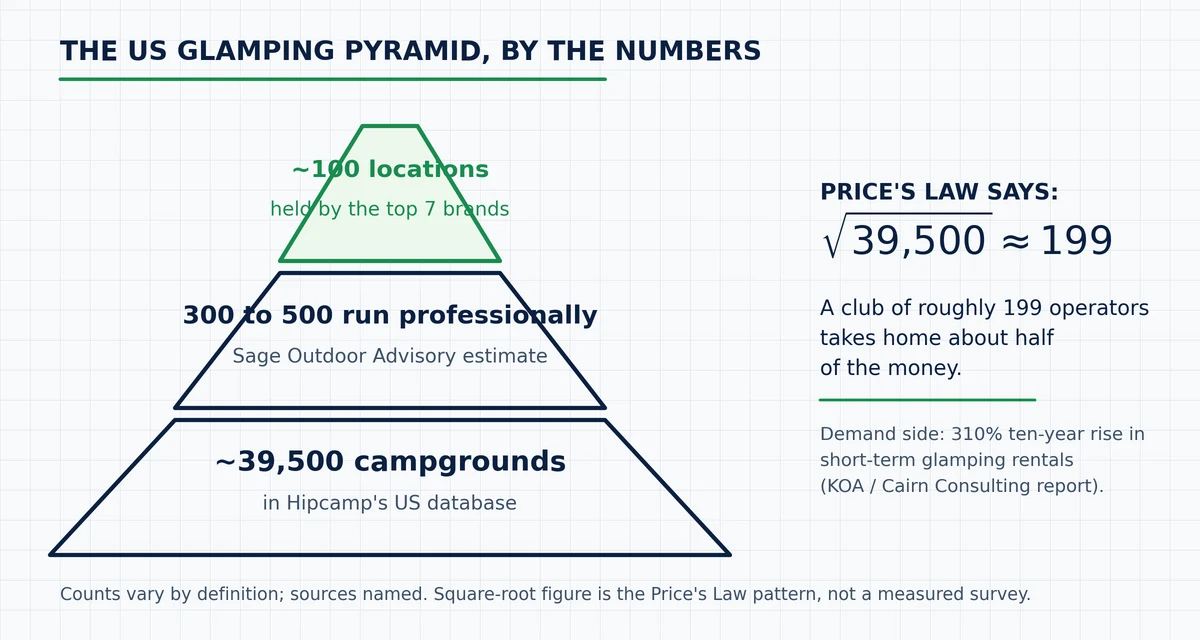
And the industry’s own numbers show the pyramid clear as day. Sage Outdoor Advisory, an advisory firm specializing in outdoor hospitality, estimates just 300 to 500 glamping operations in the whole country are professionally managed. The top 7 brands operate about 100 of those locations between them. Meanwhile demand is roaring: KOA and Cairn Consulting’s North American Glamping Report counts about 17 million households taking a glamping trip in a single year and a 310% ten-year increase in short-term glamping rentals. A market growing that fast, with a professional tier that thin? That’s not a warning sign. That’s an open door.
Here’s the part that should make you sit up: the pattern doesn’t care what the business is. Glamping. Farm-to-table dinners. Petting zoos. Food trucks. Welding shops. Roofing companies. You name it. Almost every market splits this way, and the bigger the market gets, the more brutal the split.
So the real question is never “is this market profitable?” The real question is “can I be in the square root?” I call that small group the Square Root Club, and the rest of this post is about how you get in.
Where does the real playbook hide?
Here’s the catch nobody tells you. The Square Root Club doesn’t advertise how it got there. The operator quietly clearing serious money on six off-grid cabins is not writing blog posts about his booking system or his margins. Why would he? He’d be training his own competition. Wouldn’t you keep quiet too?
Traditionally, the only way past that wall was knowing someone. A friend in the network who does it successfully and will talk over coffee. That’s a fine way to learn, if you happen to have the friend. Most people don’t.
But the winners can’t hide everything. There are public and private data sources for nearly every type of business: booking calendars, pricing moves through the seasons, review patterns, permits, land records, search demand, traffic. Every one of those is a footprint. And a business leaves footprints whether it wants to or not.
How does AI close the gap?
Reading those footprints used to be a full-time job. Now it’s exactly the kind of work AI is built for: pull the signals, compare thousands of operators, and reverse-engineer what the top ones are actually doing. What used to take knowing the right guy at the right coffee shop now takes the right analysis.
And that’s only half your edge. Here’s the other half: most of the operators already in these niches run zero AI. No AI in their marketing. None in their outreach. None in their follow-up or their maintenance scheduling. They’re answering the same guest questions by hand, every day, forever.
So when the data tells you where to play, you walk in with two advantages: the right market, and a better machine. That’s the pairing that moves you toward the Square Root Club, and it’s the same pairing whether you’re connecting AI agents to the tools you already own or building the operation data-first from day one.
Does Price’s Law show up inside big companies too?
Oh yes. If you run a larger operation, you don’t need me to prove this pattern. You’ve already felt it. Look at your own numbers and tell me if this sounds familiar:
- Your sales team: a small slice of the reps writes most of the revenue, and everyone quietly knows who they are.
- Your locations: if you run twenty or two hundred, a handful of them produce most of the profit while the long tail treads water.
- Your software shelf: a few tools carry the whole operation, and dozens more get paid every month to be barely opened.
Different animals, same arithmetic. And the enterprise move is the same as the glamping move: find your internal square root with data, then figure out what that small group does differently, and systematize it. What does your best location do that the others don’t? Which habits separate the top reps? The answers are sitting in data you already own; most companies just never run the analysis. That’s the enterprise version of a Systems Study: same math, pointed inward.
The best time to join the club is before it forms
One more thing Price’s Law teaches, and it might be the most valuable line in this post. The square root split takes time to sort itself out. In a mature market, the club seats are expensive: the winners have compounding advantages, locked-up land, locked-in customers. But in a brand-new market, the club is still forming, and the seats are cheap.
Want a live example? Workforce AI training. Right now companies everywhere are realizing their people need to actually know how to use these tools, and the market for teaching them is young. Nobody owns it yet. The same goes for AI-run service niches: the AI phone answering, the automated follow-up, the data-first versions of old-line local businesses. The operators who enter these markets early, and build on systems from day one, are not fighting their way into the Square Root Club. They’re founding the chapter.
That window is a trend, and trends close. The pattern rewards the willing and the early. You know which one the folks still scheduling a meeting about scheduling a meeting are not. ;)
Does this work for a mom-and-pop, or only big buildouts?
Both ends, and everything between. The math doesn’t care about your size; it only cares whether you asked the question before you spent the money.
- The brick-and-mortar mom-and-pop: the data question is which offer to double down on and which to quietly drop. Your own sales history plus local demand signals usually settle it fast.
- The glamping buildout: location, guest type, and price point decide everything. Occupancy and pricing footprints from operators already in the area tell you the answer before you buy land.
- The off-grid executive retreat: the guest is a CEO or owner who needs to stop checking their phone every two minutes. Unplugging IS the product. The data question is where those buyers already spend, and what they pay to disappear.
- The farm-to-table learning stay: people pay to learn something real with their hands. Demand signals and review patterns show which experiences actually book and which just sound nice at a dinner party.
- The multi-location operator: the data question is which of your locations belong to your internal square root, and which of their habits you can clone before you open the next one.
- The enterprise with 200 tools and 50 vendors: the data question is which few actually carry the operation, and what the rest cost you to keep around. Run the math before renewal season runs it for you.
- The petting zoo, the food truck, the welding shop: different animals, same arithmetic. Price’s Law always comes into play.
What does a five-year game plan look like?
Three moves, in order. Skip the first one and the other two are guesswork.
First, let the data pick the market. Before land, before leases, before logos: run the analysis. Who’s in the square root of this market, what are they doing, and is there room to do it better? Sometimes the honest answer is “this market’s club is closed, pick a different one.” That answer costs a study. The wrong buildout costs years.
Second, build the machine, not a job. Put AI to work on the parts your competitors do by hand: the marketing, the outreach, the follow-up, the maintenance reminders. Maximum profit with minimal friction only happens when the business runs on systems instead of on you skipping dinner.
Third, compound. Years three through five are where the machine pulls away from the hand-crankers. Every season of data makes your pricing smarter. Every automated follow-up stacks on the last. And the peace of mind shows up right on schedule, because a business built on systems is one you can walk away from for a week. Funny thing: if you build retreats so CEOs can unplug, you ought to be able to unplug too. ;)
One more thing, since you might be wondering why an integration guy is writing about petting zoos. I’ve stood in the dirt: farming, welding, technology, and a long list of businesses between them. I speak operator and I speak data, and most consultants only speak one. That’s why our Systems Study starts with your numbers instead of our pitch.
Is there an exception to every rule?
Always. And this one is worth knowing about before we wrap up.
Even in glamping, there are operations quietly out-earning everything we just walked through. Not by a little. Way more profit than the norm. You will never find them on a booking site, and that is exactly the point. Some of them run with twenty or thirty members. Maybe fifty, tops. Private, invitation-only, and they blow the doors off normal profitability with a fraction of the guests.
How do they pull it off? Exclusivity. Sometimes it is the location, a spot nobody else can offer. Sometimes it is the type of service, done at a level the crowd never sees. Sometimes it is the clientele itself, a tight circle that decides who gets in. There are always people willing to pay good money not to be part of the crowd. Period.
And here is the kicker: the same data-first playbook builds this model too, and you can run it while staying totally under the radar. Members instead of bookings. Referrals instead of reviews. Privacy instead of promotion. It is another angle we can help you with, but that is a conversation for later. :)
Frequently asked questions
What is Price’s Law in business?
Price’s Law comes from Derek J. de Solla Price, a historian of science who studied who actually produces the work in any field. The pattern: roughly the square root of the participants produce half the output. Applied to a market, it means a tiny group of operators takes home about half the money. In a market of 39,500 businesses, that is a club of about 199. The rest split what’s left.
Does Price’s Law apply to every business?
The pattern shows up nearly everywhere output can compound: whole markets, but also inside single companies. A small slice of a sales team tends to write most of the revenue, a handful of locations in a chain produce most of the profit, and a few vendors in any software category take most of the spend. Petting zoo or enterprise software company, different animals, same arithmetic. Which is why the useful question is always the same: where is the square root, and what are they doing differently?
How do I find out if a business idea is profitable before I start?
Study the winners before you spend a dime. Public signals exist for nearly every business type: booking calendars, pricing moves, review patterns, permits, land records, search demand. AI can read those signals at scale and reverse-engineer what the top operators are doing, so you decide with math instead of romance. That analysis is exactly what a data-first Systems Study delivers.
Why don’t successful operators share how they make money?
Because they would be training their own competition. The quiet winners in most niches don’t blog about their process or their margins. Traditionally the only way in was knowing someone in the network who does it successfully. That is exactly the information gap that data analysis and AI can now close from the outside.
How does AI help me pick a market?
Two ways. First, AI reads the signals the quiet winners can’t hide (occupancy, pricing, reviews, demand) and turns them into a picture of where the profit actually sits. Second, once you’re in, AI runs the parts most small operators still do by hand: marketing, outreach, follow-up, even maintenance scheduling. Right market plus a better machine is how you climb toward the square root group.
Want the math run before you buy the land?
Start with a 15-minute fit call. Bring the idea; we’ll talk through what the data can tell you about the market, the winners already in it, and whether there’s a seat open in the Square Root Club. No charge, no pitch, no pressure.
Book a 15-Minute Fit CallOr call or text (615) 628-7386. A human answers.
Sources for the numbers in this post: Sage Outdoor Advisory estimates of professionally managed glamping operations; Hipcamp’s published US campground database counts; KOA and Cairn Consulting Group’s North American Glamping Report. Scenario math is labeled as such. No unverified statistics, that’s house policy.